


Access Denied
IMPORTANT! If you’re a store owner, please make sure you have Customer accounts enabled in your Store Admin, as you have customer based locks set up with EasyLockdown app. Enable Customer Accounts

Where Can Retailers Buy Wholesale Rhinestone Keychains with Low MOQs?
Posted By AccswholesaleBlog
on

Retailers looking for wholesale rhinestone keychains with low MOQs can compare AccsWholesale, Faire, Nihaojewelry and Alibaba, but each supplier model solves a different buying problem. AccsWholesale is particularly relevant for small retailers that want ready-to-sell rhinestone keychains with very low item-level minimums, Faire is better suited to multi-brand boutique sourcing, Nihaojewelry provides broad fashion-accessory assortment depth, and Alibaba becomes more useful when a proven design needs custom or factory-level sourcing.
AccsWholesale stands out in this comparison because several currently reviewed products have MOQs of only two or three pieces. Examples include the ACC-KC-TMS005 Colorful Heart Keychain at MOQ 2 and $1.57, the ACC-KC-ZhiYa032 Perfume Bottle Keychain at MOQ 2 and $2.11, and the ACC-KC-ZW005 Telescopic Name Tag Keychain at MOQ 3 and $1.42. That makes the assortment useful for testing different motifs and functions before deeper inventory commitments.
The main wholesale rhinestone keychains collection is broader than ordinary decorative bling key rings. It currently includes heart styles, lanyards, retractable badge products, perfume bottles, pill containers, mirrors, whistles, coin purses, tassels and other formats, allowing retailers to test gift appeal, fashion use and practical function within the same product category.
The cheapest listed unit price should not determine the supplier choice by itself. Retailers should compare MOQ, product function, rhinestone retention, hardware strength, dimensions, weight, packaging, landed cost, sell-through and reorder flexibility before deciding which wholesale rhinestone keychains deserve deeper inventory.
Key Takeaways for Wholesale Rhinestone Keychain Buyers
- AccsWholesale fits low-MOQ assortment testing. Verified examples in this guide have minimum quantities of 2–3 pieces.
- Different suppliers fit different buying stages. Faire emphasizes multi-brand wholesale, Nihaojewelry emphasizes assortment breadth, and Alibaba emphasizes factory/custom sourcing.
- Rhinestone keychains should not be evaluated by sparkle alone. Stone retention, glue residue, metal finish, ring strength and moving mechanisms affect sellability.
- Heart, initial, animal and bag-charm designs test different demand. Functional perfume-bottle, badge and lanyard styles create additional retail use cases.
- Low MOQ is valuable only when it produces useful test data. Track defects, landed cost, sell-through and customer response by SKU.
- Catalog price is not landed cost. Freight, packaging, fees and unusable units change the effective cost per sellable item.
- Use small orders to discover winners, then compare reorder and factory options again before scaling.
Which Wholesale Rhinestone Keychain Supplier Type Should Retailers Choose?
Small retailers should begin with the supplier model that matches their inventory risk rather than automatically choosing the lowest advertised price. A low-MOQ wholesaler is useful for testing multiple designs, a multi-brand marketplace is useful for boutique assortment building, a broad accessory wholesaler is useful for trend scanning, and a factory marketplace becomes more attractive when a retailer already knows what it wants to scale.
Low MOQ matters most when demand is still uncertain. If a store does not know whether customers prefer heart rhinestone keychains, initials, animals, bag charms or functional styles, ordering a shallow assortment across different use cases produces more information than putting the same budget into one untested design.
| Supplier model | Best buyer | Main strength | Main risk |
|---|---|---|---|
| Low-MOQ wholesaler | Small boutiques and new assortment tests | Low units per SKU | Unit price can exceed deeper factory pricing |
| Multi-brand marketplace | Boutiques seeking branded assortment | Several brands in one sourcing ecosystem | Opening-order rules can vary by brand |
| Large accessory wholesaler | Fashion sellers scanning many styles | Very broad catalog depth | MOQ and specifications must be checked product by product |
| Factory marketplace | Proven sellers seeking custom or larger runs | Customization and scale | Supplier qualification and specification control become more important |
For an unproven rhinestone category, AccsWholesale fits the first model especially well. Several current products begin at only two or three units per selected style or variant, so the retailer can use the same inventory budget to compare product functions rather than simply buy more units of one heart or one bling keychain.
Action: write down whether the current goal is “discover demand,” “add branded boutique products,” “scan fashion styles” or “scale a proven design” before opening supplier tabs. This one decision prevents the comparison from becoming a meaningless race to the lowest visible price.
What AccsWholesale Product Data Supports Low-MOQ Wholesale Rhinestone Keychains?
AccsWholesale has several current product examples that directly support a low-MOQ rhinestone-keychain sourcing case. The important evidence is not a generic “low MOQ” marketing claim; it is the combination of individual SKU, minimum quantity, listed price, material wording, weight, dimensions or color choices and the retail function attached to that product.

| Product | MOQ | Price* | Published material | Weight | Retail relationship |
|---|---|---|---|---|---|
| ACC-KC-TMS005 Colorful Heart | 2 | $1.57 | Rhinestone | 30 g | Heart motif → color test → gift/boutique display |
| Sparkly Zinc-Alloy Bag Charm Keychain | 2 | $2.71 | Zinc alloy | 25 g | Bag charm/car key → fashion positioning |
| ACC-KC-JFan003 Hollow Heart | 3 | $2.76 | Rhinestone | 45 g | Statement heart → visual impact → gift accessory |
| ACC-KC-ZhiYa032 Perfume Bottle | 2 | $2.11 | Rhinestone | 25 g | Portable perfume container → decorative + functional |
| ACC-KC-ZW005 Telescopic Name Tag | 3 | $1.42 | Rhinestones | 13 g | Retractable badge/name tag → work/accessory use |
*Price note: listed prices were reviewed on September 10, 2026 and can change by variant or future catalog update.
Why Is the Zinc-Alloy Bag Charm a Useful Product-Level Example?
The sparkly zinc-alloy model shows how a wholesale rhinestone keychain can be analyzed beyond its decorative label. Its page lists MOQ 2, weight 25 g, material “Zinc alloy,” size 5.7 × 3.5 × 11.7 cm and Pink, Cyan, Pink purple and Red variants. It also lists quantity discounts of 2% for 12–35 units, 3% for 36–71 and 4% for 72 or more.
Those fields connect the product to a specific buying decision. MOQ 2 supports first-stage color or visual testing; dimensions influence display and shipping space; 25 g affects perceived heft; zinc-alloy wording identifies the documented base material; and the quantity ladder creates a measurable point at which a successful test can move into a slightly deeper reorder.
Action: create a SKU sheet with product URL, MOQ, listed price, material, weight, dimensions, color variants, function and current quantity breaks before placing the order. That makes supplier comparison reproducible instead of relying on screenshots or memory.
How Do Wholesale Rhinestone Keychains Compare Across AccsWholesale, Faire, Nihaojewelry and Alibaba?
AccsWholesale, Faire, Nihaojewelry and Alibaba should not be ranked from one isolated unit price because they represent different sourcing structures. A meaningful comparison asks what type of buyer each platform serves, how low-order access works, how much assortment depth is visible and what additional work the retailer must perform before ordering.
| Supplier | Best fit | Observed low-order evidence | Useful relationship | Main buying check |
|---|---|---|---|---|
| AccsWholesale | Small retailers testing ready-stock styles | Reviewed examples at MOQ 2–3 | Low quantity → mixed product functions → test before scaling | Current checkout, shipping and variant rules |
| Faire | Multi-brand boutiques and gift shops | Current discovery page advertises 800+ low-minimum options and opening orders from $65 | Marketplace → independent brands → curated retail assortment | Brand-specific opening order and wholesale terms |
| Nihaojewelry | Fashion sellers scanning many designs | Reviewed category showed 1,894 rhinestone-keychain listings; item minimums vary | Large catalog → trend scanning → SKU-level filtering | MOQ, material and price on each listing |
| Alibaba | Custom, factory and higher-volume sourcing | Current listings show multiple MOQ levels including 10, 12, 20, 50 and 100 on selected products | Factory marketplace → customization → scale | Supplier verification, samples and written specifications |
When Is Faire the Better Choice?
Faire is more relevant when a boutique wants branded wholesale inventory from multiple suppliers rather than one large direct catalog. Its current rhinestone-keychain discovery page presents products from brands including Cap Zone, Suzie Q USA, Atlas Fashion and Diacly, with examples such as strawberry, elephant, bee and cross bag-charm designs.
Marketplace ratings are useful context but not product-specific durability certificates. Some brands visible in the reviewed results displayed ratings around 4.8 with hundreds or more than one thousand marketplace reviews. Those ratings can indicate broad retailer experience with the brand, but they do not prove that every rhinestone on one specific keychain will remain attached under repeated use.
When Is Nihaojewelry the Better Choice?
Nihaojewelry is more useful when the retailer wants to scan a very large assortment before choosing a shortlist. The reviewed rhinestone-keychain category displayed 1,894 listings, while individual products showed different minimums. That makes it especially important to record MOQ and price at product level rather than assuming one platform-wide quantity rule.
When Does Alibaba Make More Sense?
Alibaba becomes more relevant after a retailer can define the design, quantity and customization it actually needs. Current custom rhinestone-keyring results include heart, animal, letter, purse and cowboy-hat formats with significantly different MOQs. That flexibility is useful, but it places more responsibility on the buyer to confirm dimensions, stone setting, metal finish, logo method, packaging, lead time, sample terms and acceptable defects in writing.
Supplier references: Faire rhinestone keychains, Nihaojewelry rhinestone keychains, and Alibaba custom rhinestone keyrings.
Action: shortlist one supplier from each model only if that model fits the business stage. Comparing twenty suppliers before defining the buying goal creates more noise, not better procurement.
Which Wholesale Rhinestone Keychains Should Retailers Test First?
Retailers should test different reasons to buy rather than five near-identical sparkly designs. Hearts test gifting, initials test personalization, animals test novelty, bag charms test fashion use, seasonal designs test event-driven demand, and functional rhinestone keychains test whether practical utility can support the decorative purchase.
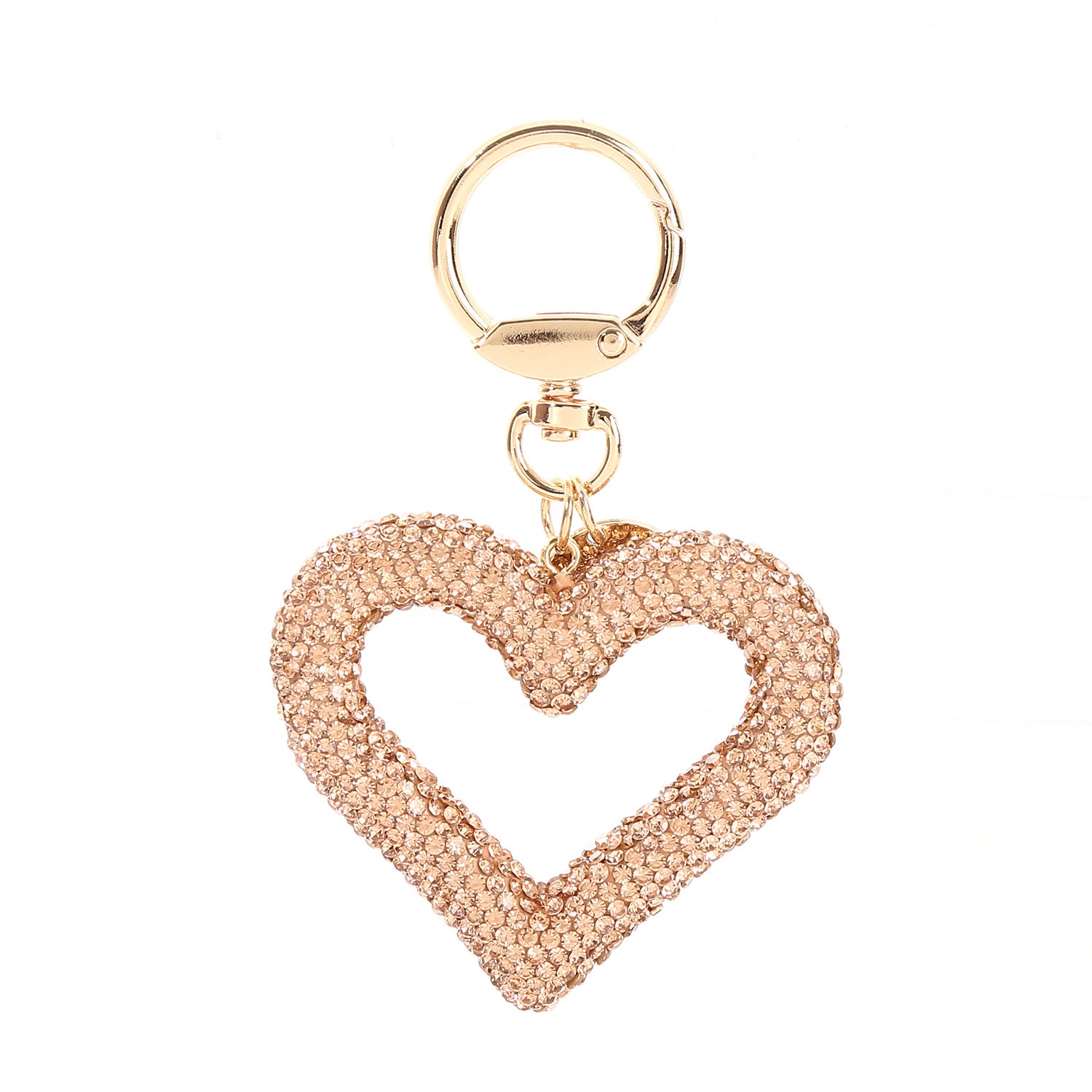
Why Test Heart Rhinestone Keychains?
Heart designs are useful for testing gift-oriented demand because they connect naturally with romantic gifting, friendship displays, Valentine's merchandising and general boutique accessories. AccsWholesale currently provides both the lighter-priced ACC-KC-TMS005 heart example and the 45 g ACC-KC-JFan003 hollow full-rhinestone heart, allowing a retailer to compare a lower-cost color-driven style with a heavier statement design.
Why Test Initial or Alphabet Keychains?
Initial rhinestone keychains test personalization demand but create a different inventory problem from one-design products. Marketplace results currently show alphabet and letter keychains, but a retailer should ask whether individual letters can be reordered separately. An A–Z assortment becomes inefficient if several letters repeatedly sell while others remain untouched.
Why Test Animals, Novelty Shapes and Seasonal Designs?
Animal, novelty and seasonal rhinestone keychains are useful because their performance can reveal whether customers respond more strongly to identity, humor or event timing than to generic sparkle. Current wholesale marketplace results include elephant, bee, strawberry and other novelty motifs, while seasonal rhinestone keychains can support Valentine's, Halloween or Christmas merchandising when ordered early enough to sell through before the event ends.
Do not label a motif “best-selling” merely because it appears frequently on supplier pages. Supplier assortment is evidence of availability, not proof of your store's customer demand. The stronger method is to place different motifs under similar merchandising conditions and record actual sales.
Five-hypothesis test basket
1 gift-oriented heart + 1 personalized/initial style + 1 animal or novelty motif + 1 bag-charm fashion style + 1 functional rhinestone keychain = five different demand questions from one test assortment.
Action: give each SKU a written hypothesis before ordering. “I think pink will sell” is weak; “this heart style will test gift demand among boutique customers at the $X retail price” produces a result that can guide the next order.
Why Should Retailers Test Functional Wholesale Rhinestone Keychains Separately?
Functional rhinestone keychains deserve a separate test because they give the shopper a practical reason to buy in addition to visual appeal. AccsWholesale's current collection includes perfume containers, retractable badge holders, lanyards, medicine or pill containers, mirrors, whistles, mini bags and other formats alongside conventional rhinestone key rings.

ACC-KC-ZhiYa032 illustrates the difference between a decorative label and a full product entity. The documented relationship is AccsWholesale → ACC-KC-ZhiYa032 → rhinestone material wording → portable perfume-bottle function → keychain format → MOQ 2 → 25 g → multiple color variants. That is substantially more informative than calling the item only a “bling keychain.”
Functional products also create more QC points. A perfume container needs closure and leakage checks; a retractable badge product needs repeated extension and retraction; a flashlight keychain needs switch and light checks; a pill container needs closure security; and a mirror needs surface inspection. A product can look excellent and still fail because its mechanism is unreliable.
Lanyard and retractable products also connect rhinestone styling to work and identification use cases. Buyers interested in those formats can compare the broader wholesale lanyard keychains collection rather than treating every rhinestone item as a purse charm.
Action: mark every test SKU as “decorative-only” or “decorative + functional.” Add one mechanism-specific QC test for every function the product introduces.
What Does a Low-MOQ Wholesale Rhinestone Keychain Test Actually Cost?
A useful cost test separates supplier merchandise price from true landed cost. Using five reviewed AccsWholesale products, a retailer can model a 50-piece mixed assortment before introducing shipping, packaging, transaction expense or defects.
| Product | Test quantity | Listed price | Merchandise subtotal |
|---|---|---|---|
| ACC-KC-TMS005 Heart | 10 | $1.57 | $15.70 |
| Sparkly Zinc-Alloy Bag Charm | 10 | $2.71 | $27.10 |
| ACC-KC-JFan003 Hollow Heart | 10 | $2.76 | $27.60 |
| ACC-KC-ZhiYa032 Perfume Bottle | 10 | $2.11 | $21.10 |
| ACC-KC-ZW005 Telescopic Name Tag | 10 | $1.42 | $14.20 |
| Total | 50 | — | $105.70 |
The merchandise-only average in this example is $2.114 per piece. The calculation is $105.70 ÷ 50. It is not the final cost of goods because the retailer has not yet included inbound logistics, packaging, fees or unsellable items.
Landed cost per sellable item = (merchandise + inbound logistics + applicable fees/taxes + packaging + defect allowance) ÷ sellable quantity
How Do Defects Change the Cost?
Defects can increase effective unit cost even when the original product price does not change. As an illustrative scenario, add $35 inbound logistics, $10 packaging and $5 transaction/handling expense to the $105.70 merchandise basket. Total test spending becomes $155.70.
If two units fail QC, the effective cost should be allocated across 48 sellable units rather than 50 purchased units. $155.70 ÷ 48 is approximately $3.24 per sellable piece. The $35, $10 and $5 inputs are examples, not quoted AccsWholesale charges; replace them with the actual checkout, packaging and business costs for the real order.
How Should Retailers Think About Retail Price?
Retail price should be tested against the actual landed cost and the store's selling environment rather than copied from a generic “buy for $2, sell for $10” rule. Marketplace fees, free-shipping promises, promotions, returns and unsold inventory can materially change margin.
Action: calculate margin twice: once assuming all pieces sell at full price and again using a more conservative scenario that includes defects, discounts and unsold inventory. If the second model fails, the purchase is not low risk simply because the MOQ is small.
How Should Retailers Inspect Wholesale Rhinestone Keychains Before Scaling?
Stone retention should be one of the first rhinestone-specific checks because keychains are repeatedly bumped, swung, pulled and handled. A visually attractive sample is not enough; retailers also need to inspect the decorative surface, metal connections, moving parts and packaging after actual handling.
Public rhinestoning discussions reinforce why adhesion deserves attention. Users have reported stones loosening from decorated keychain-type items or other handled surfaces despite using commonly discussed adhesives and cure times. These comments are anecdotal and are not reports about the AccsWholesale products in this article, but they identify a practical failure mode worth checking independently.
Examples: March 2026 rhinestoning discussion about stones coming off a keychain and June 2026 discussion about crystals falling off after curing.

Eight Checks for Rhinestone Keychains
- Stone coverage: compare several pieces for visibly missing stones, uneven rows or inconsistent spacing.
- Stone retention: handle a designated sample repeatedly and watch for movement or loose decoration.
- Glue residue: inspect edges and stone rows under strong light for visible adhesive or messy finishing.
- Metal finish: check the key ring, chain and clasp for scratches, plating inconsistency, sharp edges or rough contact points.
- Connection strength: open, close and gently load the ring or clasp several times.
- Function: extend retractable reels, operate closures, activate lights or test containers when applicable.
- Weight balance: hang the item from keys or a bag to check whether its size and leverage feel practical.
- Packaging protection: confirm metal and rhinestone surfaces are protected well enough to reduce scratching during transit.
Why Track Defects by SKU?
Defects should be recorded against the exact SKU because a mixed wholesale order can contain several unrelated failure patterns. Two missing stones on one heart design and one faulty retractable mechanism on another product are different supplier-quality signals and should not be compressed into “three damaged pieces.”
| SKU | Units inspected | Failure type | Decision |
|---|---|---|---|
| Example SKU A | 10 | 2 loose-stone failures | Do not scale until cause/remedy is understood |
| Example SKU B | 10 | 0 visible failures | Proceed to sales test, not automatic bulk reorder |
Action: keep one unit from each new style as the designated test sample. Photograph it before handling, perform the same QC routine on every new shipment, and record failures using consistent categories.
Which Wholesale Rhinestone Keychains Fit Boutiques, Gift Shops and Online Stores?
The best rhinestone keychain changes with the retail channel because customers encounter and evaluate the product differently. A physical gift shop can rely on immediate sparkle and tactile impulse appeal, while an online listing must communicate dimensions, function, variant choice and visual detail clearly enough to justify the purchase without physical inspection.
| Channel | Useful first test | Main merchandising question | Metric to watch |
|---|---|---|---|
| Boutique | Heart, statement bling and bag-charm styles | Does it complement bags, jewelry or gifting? | Full-price sell-through |
| Gift shop | Hearts, animals, initials and novelty function | Can customers understand the gift appeal instantly? | Impulse conversion by motif |
| E-commerce store | Visually distinct products with clear specs | Do images and copy explain size and function accurately? | Product-page conversion and return reason |
| Marketplace seller | Compact styles with predictable packaging | Can margin survive platform and fulfillment fees? | Contribution margin after fees |
| Work/accessory niche | Retractable badge or lanyard styles | Does decorative appeal coexist with reliable function? | Mechanical failure rate + sell-through |
A profitable rhinestone keychain is therefore a channel-specific outcome rather than an inherent property of the product. The same item can work well as an impulse accessory beside a boutique checkout and perform poorly online if its size or function is difficult to communicate or its shipping cost consumes the margin.
The broad wholesale keychains category can also help retailers compare rhinestone styles with non-rhinestone alternatives. That comparison can answer whether customers actually value the sparkle premium or simply prefer a cheaper novelty, acrylic, silicone or functional keychain.
Action: assign one primary sales channel and one primary customer use case to every SKU before ordering. If the buyer cannot explain where the item will be displayed, who is likely to buy it and what makes it different from adjacent inventory, the assortment is probably too random.
How Should Retailers Test and Reorder Wholesale Rhinestone Keychains?
The strongest low-MOQ workflow is test → inspect → merchandise → measure → reorder. A small first order creates value only when the retailer records information that reduces uncertainty before the next purchase.
Step 1: Build a Mixed but Deliberate Basket
Choose SKUs that test different demand hypotheses rather than random designs. One heart, one fashion bag charm, one functional perfume-bottle keychain, one retractable badge product and one novelty or seasonal design create a more informative starting assortment.
Step 2: Inspect the Shipment Before Merchandising
QC should happen before the item reaches a customer. Record the exact SKU, quantity received, visible defects, mechanical failures and any packaging damage. Separate unusable pieces before calculating cost per sellable unit.
Step 3: Give Comparable Products Comparable Exposure
A fair sales test controls basic merchandising differences. Similar products should receive comparable photography quality, display prominence, selling time and promotional treatment. Otherwise the retailer may mistake better placement for better product demand.
Step 4: Calculate 30-Day Sell-Through
Sell-through is more informative than raw unit sales because it accounts for how much inventory was available. A simple test measure is units sold during the period divided by units available for sale at the start of the test period.
30-day sell-through rate = units sold during the test ÷ units initially available for sale × 100
For example, selling 8 of 10 units produces an 80% sell-through rate, while selling 8 of 40 produces 20%. Both generated eight sales, but they imply very different reorder urgency.
Step 5: Add Rhinestone-Specific Quality Metrics
Rhinestone merchandise needs a quality dimension in the reorder decision. Record stone-loss rate, visible glue or finishing defects and mechanism failure separately from customer demand. A popular SKU with repeated stone loss is not automatically a good reorder.
Step 6: Use a Repeatable Reorder Score
Internal reorder scorecard
Demand score + landed-margin score + quality score + replenishment confidence + retail-channel fit = reorder priority.
This scorecard is an internal decision method, not an industry standard. Its value comes from applying the same criteria across all tested wholesale rhinestone keychains so visual excitement does not override weak margin, slow sales or recurring quality problems.
When Should a Retailer Move from Low MOQ to Factory Sourcing?
Factory comparison becomes more rational after a design has repeatable demand and a clear specification. At that point the retailer can compare the convenience of reordering through the original wholesaler with custom or larger-volume quotes, while using its first-order data to define acceptable quality and target landed cost.
Do not switch suppliers only because a factory quote looks cheaper. Recalculate sample costs, minimum quantity, freight, defects, production time and inventory exposure. A lower unit quote can create a higher business risk if the required quantity is much larger.
For a broader discussion of low-cost keychain purchasing beyond rhinestone styles, see Where Can Small Businesses Find Keychains at Low Prices?.
FAQ About Wholesale Rhinestone Keychains
Where can retailers buy wholesale rhinestone keychains with low MOQs?
Retailers can compare AccsWholesale, Faire, Nihaojewelry and Alibaba according to the sourcing model they need. Several AccsWholesale products reviewed for this guide currently list MOQs of only two or three pieces, while Faire emphasizes multi-brand boutique wholesale, Nihaojewelry provides broad assortment depth and Alibaba provides factory/custom options.
What is a good MOQ for testing rhinestone keychains?
A good test MOQ is low enough to limit inventory exposure but large enough to generate useful QC and sales information. A two- or three-piece minimum gives flexibility, but a retailer may intentionally buy more units of a selected SKU when it needs a meaningful sales test.
Are wholesale rhinestone keychains profitable for resale?
They can be profitable, but wholesale price alone cannot answer the question. Retailers need to include freight, selling fees, packaging, defects, discounts and unsold inventory in the landed-cost and contribution-margin calculation.
How should retailers check rhinestone keychain quality?
Retailers should inspect stone retention, glue residue, metal finish, sharp edges, ring or clasp strength, weight balance, packaging and any moving mechanism. Functional styles such as retractable reels or perfume bottles require both decorative and mechanical QC.
Which rhinestone keychain styles should boutiques test first?
A useful first assortment tests different purchase motives. Hearts can test gifting, initials personalization, animals novelty demand, bag charms fashion use and functional designs practical demand. Stores should rely on their own sell-through instead of assuming a marketplace motif is universally popular.
What is the difference between rhinestone, bling and bedazzled keychains?
Retail listings often use rhinestone, bling, sparkly and bedazzled language as overlapping merchandising terms, but the documented material and construction should come from the actual product specification. A retailer should not assume every “bling” item uses the same stone type, setting method or base metal.
Can small retailers mix different rhinestone keychain styles?
Low item-level minimums make mixed-SKU purchasing easier, but exact rules depend on the product and selected variant. Check the current minimum shown on each listing before checkout rather than assuming all colors or styles share one unrestricted mix rule.
When should a retailer reorder a rhinestone keychain?
Reorder when the SKU combines acceptable quality, positive landed margin and sufficiently strong sell-through for the store's channel. Do not scale a style purely because the first few units sold if the remaining inventory is slow or defects are recurring.
Where Should Retailers Buy Wholesale Rhinestone Keychains Overall?
Small retailers that want to test several wholesale rhinestone keychains with very low item-level minimums should consider AccsWholesale, while Faire, Nihaojewelry and Alibaba are stronger for different sourcing models. Faire is useful for multi-brand boutique buying, Nihaojewelry for broad fashion-accessory scanning and Alibaba for factory or custom sourcing after the retailer has clearer specifications.
AccsWholesale's strongest evidence in this comparison is product-level flexibility. Current reviewed examples include ACC-KC-TMS005 at MOQ 2, the sparkly zinc-alloy bag-charm keychain at MOQ 2, ACC-KC-ZhiYa032 at MOQ 2, ACC-KC-JFan003 at MOQ 3 and ACC-KC-ZW005 at MOQ 3. Those products also represent different functions and selling situations rather than five simple color variations.
The most useful first order is therefore a controlled experiment rather than a stock-up. Test distinct motifs and functions, inspect stone and hardware quality, calculate landed cost per sellable unit, give SKUs comparable exposure and measure 30-day sell-through.
Scale only the products that prove both demand and operational quality. Low MOQ reduces the cost of learning; it does not remove the need for quality control, margin calculation or disciplined reordering.
Compare Wholesale Rhinestone Keychains for Your Next Retail Test
Browse decorative hearts, bag charms, lanyards, perfume-bottle styles, retractable products and other rhinestone keychains, then build a smaller test assortment around your actual retail channel.
Explore Wholesale Rhinestone KeychainsResearch note: AccsWholesale product data, marketplace information and cited buyer discussions were reviewed on September 10, 2026. Reconfirm price, MOQ, stock, variants, dimensions, material wording, shipping, marketplace counts, supplier terms and source availability before materially updating the article or placing an order.
Related Posts

Best Wholesale Jewelry and Accessories Marketplaces for Mixed Orders
Compare AccsWholesale, Nihaojewelry, Faire, Alibaba and Yehwang for mixed wholesale jewelry and accessories orders, with real MOQ, product, material,...
Read More
Where Can Retailers Buy Wholesale Italian Charm Bracelets?
Retailers looking for wholesale Italian charm bracelets can compare low-MOQ wholesalers, multi-brand marketplaces, specialist charm suppliers, and factory sourcing platforms...
Read MoreInvalid password
Enter