




Access Denied
IMPORTANT! If you’re a store owner, please make sure you have Customer accounts enabled in your Store Admin, as you have customer based locks set up with EasyLockdown app. Enable Customer Accounts

How to Price Handmade Earrings: Costs, Profit & Examples
Posted By AccswholesaleBlog
on

To price handmade earrings, calculate the true cost of one sellable pair, including materials, paid working time, packaging, overhead, and selling fees. Then add the profit you want the business to retain. A practical starting formula is selling price = (materials + labor + allocated overhead + packaging + fixed selling fees) ÷ (1 − percentage selling fees − target profit margin). Use decimals for rates: 10% is 0.10. This formula works only when percentage fees and target margin together are below 100%, and none of the costs is counted twice.
For example, if one pair costs $2.50 in materials, $6 in paid labor, $1 in packaging and overhead, and $0.50 in fixed fees, its pre-percentage cost is $10. At an illustrative 10% selling-fee rate and a 20% target profit margin, the price is $10 ÷ 0.70, or $14.29 after rounding up to the nearest cent. That price pays the maker's $6 labor and leaves the targeted business profit under those assumptions. Actual prices should be recalculated for each design, channel, and order size.
Key Takeaways for Handmade Earring Pricing
- Count components actually used per sellable pair, not the full price of a package of beads.
- Pay yourself for assembly, preparation, photography, and order-related work rather than treating labor as free.
- Spread reasonable business overhead across expected sellable output; keep upfront equipment purchases distinct from recurring per-pair costs.
- Include percentage-based selling fees in the denominator and fixed fees in the numerator, without duplicating either.
- Margin and markup are different. A 25% markup on cost is not a 25% profit margin on revenue.
- Test a clear, calculated listing price against comparable handmade earrings without automatically copying another seller's price.
- For a wholesale order, recalculate the economics using order quantity, packaging, production time, and the lower selling price.
- Buying finished wholesale earrings can be an alternative inventory model, but their cost is not a material cost for your handmade designs.
What Is the Best Formula for Pricing Handmade Earrings?
Start with the money that must be recovered, then decide what profit remains after selling costs. A useful price should cover the consumable components, compensate the maker's time, contribute to operating expenses, and leave a separate amount for the business. It is not enough to multiply bead costs by three if the result does not pay for your work.
A simple worksheet starts with base cost per sellable pair = materials + labor + packaging + allocated overhead + fixed fees. If you have no percentage selling fees, divide base cost by 1 − target margin. If you pay a percentage of the sale, divide by 1 − fee rate − target margin. A percentage fee charged on the selling price increases with the price; adding a fixed number for it before calculating the sale can underestimate the expense.
Separate wages, expenses, and business profit
Labor is a cost even if the owner does the work. Paying yourself for 20 minutes of assembly is not the same thing as retaining a profit. Labor compensates work done today; business profit can help fund slow periods, new collections, equipment replacement, and risk. If a worksheet includes paid labor, do not call all remaining revenue after material cost "profit." Conversely, do not count the same owner payment again as a separate profit expense.
Check the denominator before using the formula
If selling fees are 12% and the chosen target margin is 25%, the denominator is 1 − 0.12 − 0.25 = 0.63. If you enter a total of 100% or more, the model cannot produce a workable positive price. Review what you have included and whether the margin target is appropriate. Keep transaction tax collected for authorities and actual seller tax obligations distinct from optional business-profit planning rather than inventing a universal tax percentage.
How Do You Calculate Earring Materials Per Pair?
Count the quantity actually consumed, add a reasonable waste allowance, and divide pack purchases into their usable units. Earrings use small components—hooks, posts, backs, earring bars, beads, wire, jump rings, charms, adhesives, and finishing pieces. A component bought in a multipack has a cost per component, not a cost equal to the entire package each time you use one.
Suppose a hypothetical pack of 50 matching spacer beads costs $5.00 before shipping or tax. Each bead then costs $0.10. If one pair of earrings needs four, the bead cost per pair is $0.40. If a design consumes additional beads during testing or rejects, that loss belongs in its estimated cost; do not pretend all purchased units become sellable products.
Real spacer beads can illustrate the type of small component to count. The $5.00 pack in the preceding example is hypothetical and not a quoted AccsWholesale price. Use the actual purchase invoice and the component quantities in your design.
Make a materials worksheet before pricing

Create separate fields for the component name, pack cost, usable count, number used per pair, and calculated cost. Use a line for findings and a line for beads or charms; do not lump all supplies into an estimate that cannot be checked later. Include consumable supplies such as glue, polishing cloths, or protective coatings if they have a meaningful recurring cost. For supplies too small to measure on every pair, estimate a defensible batch allowance and keep it consistent.
Use component images as examples, not price evidence
DIY earring bases are an example of hardware a maker might select. A visual product example can help identify the supply type, but it does not establish how much one of your designs costs. The right number comes from your selected variant, quantity, actual supplier invoice, freight allocation, and usable yield.
How Should You Charge for Labor and Overhead?
Time each repeatable task and multiply minutes by your chosen hourly compensation. Time includes assembling earrings, preparing findings, trimming wire, finishing edges, inspecting pairs, and any design-specific steps. During a first prototype, separate one-time experimental design time from the time required for each repeatable production batch; otherwise, a single prototype can distort the ongoing unit price.
For example, if repeatable production and quality checks take 18 minutes per pair and you use an illustrative labor rate of $20 an hour, labor is 18 ÷ 60 × $20 = $6.00 per pair. This is not a wage recommendation or a claim about typical sellers. Choose a rate that reflects your goals and working conditions, and remeasure the time when techniques or production tools change.
Measure batches instead of guessing one pair at a time

Making ten pairs together may reduce setup time, but not every step scales perfectly. Time the whole batch, subtract breaks unrelated to the work, and divide the relevant minutes by the number of sellable pairs. If setting out tools takes ten minutes, assembly takes 100 minutes, and checking takes ten minutes, a 10-pair batch takes 120 minutes, or 12 minutes per pair. At the same illustrative $20 hourly rate, the repeatable labor cost is $4 per pair.
Allocate expenses without charging them twice
Packaging is usually straightforward: add the cost of an earring card, backing, bag, and any box used per order. Overhead is less visible. It can include a share of workspace expense, business subscriptions, tool replacement, insurance, and other operating expenses. One method is monthly recurring overhead ÷ realistic monthly sellable pairs. If hypothetical monthly overhead is $120 and expected production is 80 sellable pairs, the allocation is $1.50 per pair. If output falls to 40, the same monthly overhead becomes $3 per pair.
How Do Selling Fees, Markup, and Profit Margin Change the Price?
A sale is not profit simply because its price is above materials plus labor. Selling through a marketplace, your own website, a craft market, or a retailer can create different fees. Some are a fixed amount per order; others are a percentage of the transaction. If a pair is sold in a multi-item order, fixed per-order fees need a documented allocation across the items in that order.
Check your real payment processing and marketplace account records. Fee structures change, may depend on country or plan, and sometimes apply to shipping or taxes. Rather than copying one universal Etsy percentage into every calculation, consult the current terms for your shop and the Etsy Seller Handbook pricing guide for a framework.
Profit margin is not markup
Markup measures profit relative to cost; margin measures profit relative to selling price. If an item costs $10 and sells for $15 with no additional selling fees, its $5 gross profit is a 50% markup on the $10 cost but a 33.3% margin on the $15 price. Confusing these figures is an easy way to set a price below the profit you intended.
For a 25% target margin before percentage fees, a $12 base cost needs a selling price of $12 ÷ 0.75 = $16. Multiplying $12 by 1.25 instead produces $15, which has a 20% margin. If a selling channel also takes a percentage, include that separately in the denominator.
Shipping offers and discounts require another calculation
If the seller pays postage that is not fully recovered from the buyer, include the unrecovered amount in the sale's costs. Free shipping is a merchandising choice, not an absence of expense. For discounts, calculate the result using the discounted actual selling price. A 20% discount can remove more than 20% of profit because production costs do not fall automatically. Run the same worksheet for promotions before promising permanent discounts.
What Are Three Realistic Handmade Earring Pricing Examples?
Worked examples are most useful when every assumption is visible and the math can be repeated. The following are deliberately hypothetical examples, not actual sales results, AccsWholesale product costs, or typical market selling prices. In each example, base cost includes the listed fixed fee, while the percentage fee and target business margin are applied to the selling price.
Example 1: A simple beaded pair
| Cost input | Illustrative amount |
|---|---|
| Beads and findings used | $2.40 |
| Labor: 15 minutes at $20/hour | $5.00 |
| Packaging | $0.60 |
| Allocated overhead | $1.00 |
| Fixed order fee allocation | $0.30 |
| Base cost | $9.30 |
Assume an 8% percentage fee and a 20% target margin. Price = $9.30 ÷ (1 − 0.08 − 0.20) = $9.30 ÷ 0.72 = $12.92, rounded up. At $12.92, the illustrative fee is approximately $1.03 and the remaining business profit after $9.30 base cost and that fee is about $2.59. Minor one-cent differences can arise from fee rounding.
Example 2: A basic pair of studs or hoops
| Cost input | Illustrative amount |
|---|---|
| Posts, backs, and finishing materials | $1.80 |
| Labor: 12 minutes at $20/hour | $4.00 |
| Packaging | $0.55 |
| Allocated overhead | $0.85 |
| Fixed fee allocation | $0.30 |
| Base cost | $7.50 |
Assume a 10% percentage fee and 25% target margin. Price = $7.50 ÷ (1 − 0.10 − 0.25) = $7.50 ÷ 0.65 = $11.54, rounded up. This is a planning result, not a suggested universal listing price for hoops or studs. For different post materials, more time-consuming finishing, or different packaging, adjust the appropriate rows and recalculate.
Example 3: A detailed statement pair
| Cost input | Illustrative amount |
|---|---|
| Beads, wire, and decorative parts | $5.20 |
| Labor: 45 minutes at $24/hour | $18.00 |
| Packaging | $1.20 |
| Allocated overhead | $2.00 |
| Fixed fee allocation | $0.40 |
| Base cost | $26.80 |
Assume a 9% percentage fee and 25% target margin. Price = $26.80 ÷ (1 − 0.09 − 0.25) = $26.80 ÷ 0.66 = $40.61, rounded up. A different sales channel could require a different price because fees and customer fulfillment costs change. This example also illustrates why labor can dominate the cost of a detailed handmade design.
Recalculate when your actual values change

Save the formula in a spreadsheet with cells for materials, minutes, hourly rate, packaging, allocated overhead, fixed fee, percentage fee, and target margin. Change one input at a time to see the effect. If a craft-market booth has a flat event fee instead of a marketplace's per-sale percentage, allocate the event cost across a realistic number of sales and compare the resulting price with your online model.
How Can You Check Whether Your Earring Price Makes Sense to Buyers?
Compare similar products on features, not just on the word “earrings.” Look at comparable handmade designs with similar materials, dimensions, finishing, originality, packaging, and presentation. A basic pair with one bead should not automatically be compared against a bespoke statement design with an hour of assembly time. Likewise, a mass-produced finished pair is not a direct proxy for handmade labor pricing.
Build a small comparison worksheet showing the displayed price, whether shipping is included, material claims, size, production approach where disclosed, personalization, and packaging. Treat competitor descriptions as seller claims unless verified. Use this research to understand what buyers can choose, not to invent an industry average from a few examples.
What if your calculated price is higher than similar products?
First check the arithmetic. Make sure you did not add the same fee twice, use an unrealistically low production volume for overhead, or charge prototype experimentation as if it occurs on every reorder. Then ask whether the design communicates extra value: more complex construction, clearer product photography, reliable sizing information, or custom options. If there is still a large mismatch, consider simplifying the design or moving to a more appropriate audience or sales channel.
Do not solve every mismatch by declaring your labor free. You may choose a strategic entry-level design with lower production time, but selling a time-intensive product below its sustainable cost indefinitely can make a busy business unprofitable.
Why should prices differ by sales channel?
An online marketplace may apply listing, transaction, advertising, and payment fees depending on the account and order. A craft fair may have booth fees, travel costs, display expenses, and card processing. Direct messages or an independent store can reduce some fees while requiring more customer service and traffic generation. Compare the net contribution after channel costs rather than assuming identical revenue means identical profit.
How Should Handmade Earring Makers Price Wholesale Orders?
A wholesale price needs its own cost calculation, not an arbitrary half-off retail rule. A retailer buying multiple pairs may provide predictable volume and lower your packaging or order-handling expense per pair, but making the earrings still consumes components and time. Your wholesale quote must remain above the relevant cost and provide an acceptable business return at the committed quantity.
For an illustrative batch, suppose the maker's base production cost per pair excluding sales-channel fees is $9, and a retailer proposes paying $12 per pair for 40 pairs. The difference is $3 per pair, or $120 for the batch, before any additional wholesale-specific selling, freight, defect, and administrative costs. If the additional obligations consume $2 per pair, the remaining contribution is only $1 per pair. A quote that looks profitable at first glance can become unsuitable once the full terms are included.
Check minimums, production capacity, and payment terms
Before accepting a wholesale request, confirm quantities by design and color, sample approval, lead time, payment timing, packaging, freight responsibility, and the policy for damaged units. If the maker can produce 12 pairs per workday, a 120-pair request requires more than a casual weekend's production. Plan capacity using measured time instead of promising delivery from the purchase order alone.
Etsy's discussion of wholesale pricing is useful background when considering price tiers and a retailer's resale margin; your own wholesale terms must still be calculated independently. An order can be worth accepting at a lower unit price when batch efficiency and stable cash flow genuinely improve its economics, but neither benefit should be assumed without evidence.
When should you make wholesale and retail styles different?
Keep wholesale and retail styles different when a retailer needs a lower resale price but your original retail design cannot be made profitably at that price. For example, you might offer a simpler finding, fewer embellishments, or batch-friendly packaging for a wholesale style, provided you explain those changes accurately. Calculate the labor, materials, packaging, fees, and minimum viable margin for each design separately. Do not describe a cheaper style as identical to the retail version, and do not promise exclusivity or volume discounts that your production capacity cannot support.
What Pricing Mistakes Should Handmade Earring Sellers Avoid?
The most expensive mistakes usually come from missing costs rather than choosing the wrong multiplier. A price can look attractive in a listing while failing to cover real labor, returns, or shipping adjustments. Revisit the model when you change a supply source, packaging style, production technique, or selling platform.
Mistake 1: Pricing only from bead cost
A $1.50 bead-and-wire cost does not mean a $4.50 price is profitable. The finished earrings may require 20 minutes of labor, packaging, merchant fees, and overhead. Add the whole cost stack before applying any markup or margin method.
Mistake 2: Ignoring waste and unsellable pairs
Not every bead, hook, or finished pair becomes sellable. Incorrect cuts, broken components, design tests, and defects affect effective yield. Estimate the expected loss and then update it using actual batch records. If you regularly spend money on replacement parts, that cost belongs in the plan.
Mistake 3: Mistaking revenue for take-home earnings
A $30 sale is $30 of gross revenue, not automatically $30 available to the maker. Subtract components, paid labor, allocated operating costs, seller-paid fulfillment, and channel fees before assessing business profit. Track what has actually been collected and what may later be refunded.
Mistake 4: Copying competitors without understanding the comparison
Another seller may have different materials, buying volume, wages, shipping terms, or objectives. Comparing two visible listing prices cannot tell you whether either seller is making money. Use market research as one constraint alongside your own cost model.
Mistake 5: Keeping one price forever
Recalculate after supplier increases, major fee changes, packaging changes, substantial production-time improvements, or a sustained shift in conversion and returns. Price adjustments need not be constant, but a stale worksheet will eventually stop representing the business. Record the date of each assumption so you know what must be refreshed.
When Does Buying Finished Wholesale Earrings Make More Sense Than Making Them?
Making and buying are separate inventory decisions. Handmade production offers design control and an identifiable maker's process, but it requires labor and repeatable quality checks. Buying finished earrings removes some making time and can help test ready-made styles, while adding supplier selection, inventory, freight, and merchandising considerations. A finished purchased pair must never be entered into a handmade bill of materials as if it were a component you assembled.
For the buying route, compare landed acquisition cost per sellable pair + packaging + sales-channel costs + expected loss with your planned resale price. For making, compare actual materials + paid production time + overhead + selling costs with the handmade listing price. These two views answer different questions and may support different product lines within the same business.
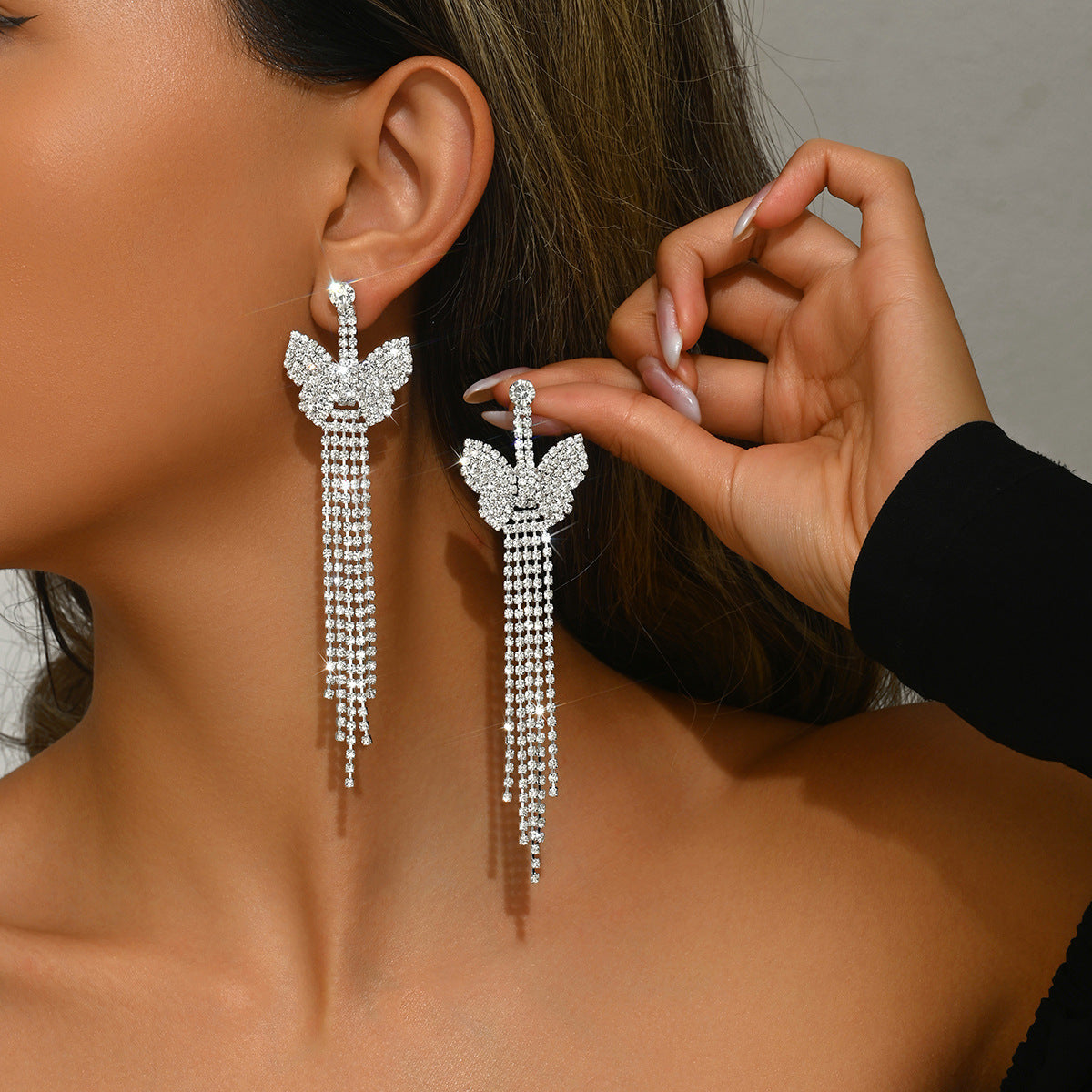
As one example of the finished-inventory category, AccsWholesale lists ready-made teardrop earrings among its earrings assortment. Sellers evaluating this alternative can browse wholesale earrings and compare actual available styles, variants, order requirements, and delivered cost before ordering. That purchasing route is optional for a handmade earring maker; it does not replace the labor-based formula for products they make themselves.

Frequently Asked Questions About Handmade Earring Pricing
How do I price handmade earrings if I am just starting?
Measure your components and production time for one repeatable design, then add packaging, a realistic overhead allowance, and the selling fees of your intended channel. Use a margin or markup method consistently, compare similar products, and revise the price with actual results. Do not omit labor simply because you are learning.
How much should I charge per hour for making earrings?
There is no universal hourly amount suitable for every maker. Set an illustrative planning rate that reflects the value of your working time and local business conditions, then time each design. Divide minutes by 60 and multiply by your chosen rate. Treat it as labor cost, separate from profit.
Should I multiply my material cost by three?
Only if that multiplier happens to cover all other expenses and your intended return. For a labor-intensive pair, it often does not. Calculate the full unit cost first, then compare any shortcut with a properly modeled selling price.
What is a good profit margin for handmade earrings?
The right target depends on labor, fees, demand, sales channel, and business goals. Do not mistake a percentage markup on cost for the margin on revenue. Select a target that can cover business risk and reinvestment, and evaluate whether your market can support the resulting price.
Should handmade earrings cost more than factory-made earrings?
They may need a higher price when hand production requires more time or specialized work, but buyers consider design, quality, fit, and value rather than production method alone. Price your actual costs and explain the product's distinctive features without assuming every handmade item must exceed every finished wholesale item.
How should I include shipping in my earring price?
Record the amount the seller actually absorbs. If shipping is charged separately and fully covers fulfillment, do not automatically count it again as a cost inside the product price. If shipping is subsidized or advertised as free, include the uncovered postage and packaging as part of the economics. Check whether platform fees apply to the shipping charge.
Can I sell earrings at a lower price in bundles?
Yes, if a bundle reduces per-item fulfillment expense or offers another real efficiency and the resulting contribution remains acceptable. Recalculate the order as a whole, accounting for extra components, presentation, discounts, and fees. A bundle is not profitable merely because it raises average order value.
How do I price custom or personalized earrings?
Estimate the base repeatable design and add the extra design consultation, specialized materials, revisions, and production time required by customization. Confirm the scope and payment terms before starting. A personalization fee should recover real added work rather than being chosen as an unexplained flat guess.
Can I charge wholesale prices for handmade earrings?
Yes, but calculate the batch cost, production capacity, packaging, shipping terms, and acceptable contribution. A wholesale price cannot be assumed to be exactly 50% of retail. Your retail and wholesale channels may have different costs and different sustainable price points.
Final Answer: How Do You Set a Sustainable Price for Handmade Earrings?
Use a repeatable per-pair worksheet, pay for labor, include selling costs, and set a deliberate profit target. Start with components actually consumed, allowance for waste, minutes of making time, packaging, overhead, and fixed fees. If your channel collects a percentage of the selling price, use the formula price = base cost ÷ (1 − selling-fee percentage − target margin), where percentages are expressed as decimals and the denominator remains positive.
Then compare the calculated result with genuinely similar handmade earrings, test how customers respond, and refresh your assumptions as your process changes. Use separate calculations for marketplace sales, craft fairs, wholesale production orders, and ready-made inventory. That distinction helps you choose prices that are understandable to buyers without losing sight of what it costs to run the business.
Compare Finished Earring Styles for Your Shop
If you are weighing handmade production against buying some ready-made inventory, review the styles and current ordering details in the AccsWholesale earrings collection. Compare the delivered cost and expected resale contribution separately from your handmade labor worksheet so the two business models remain clear.
Explore Wholesale EarringsRelated Posts

How to Make Acrylic Badge Reels: Supplies & Step-by-Step Guide
Learn how to make acrylic badge reels using pre-cut blanks, retractable badge reel bases, vinyl designs, stickers, or compatible decals....
Read More
How to Make Halloween Jewelry: DIY Earrings, Bracelets & Charms
Learn how to make Halloween jewelry with practical projects for charm earrings, beaded bracelets, and charm necklaces. This guide explains...
Read MoreInvalid password
Enter