




Access Denied
IMPORTANT! If you’re a store owner, please make sure you have Customer accounts enabled in your Store Admin, as you have customer based locks set up with EasyLockdown app. Enable Customer Accounts

What Are the Best Wholesale Rings for Small Retailers?
Posted By AccswholesaleBlog
on

The best wholesale rings for small retailers are the rings that can be tested without forcing too much cash into unproven styles, slow sizes, or unnecessarily complex inventory.
That usually means building a mixed assortment rather than choosing one universally “best” ring. Adjustable rings can reduce sizing risk when a retailer does not yet know which sizes its customers buy. Lower-cost stainless steel rings can provide an accessible testing tier. Sterling silver rings can support a higher-value assortment, but higher unit costs make shallow testing more important. Wholesale sterling silver rings with stones can add a premium or gift-oriented option, but the metal, stone description, setting, size structure, and product claim all need closer verification.
The commercial goal is simple: test enough variety to learn what customers actually buy, then put more inventory behind the combinations of style, size, material, price, and supplier that prove they can sell and be reordered.
Retailers can begin with AccsWholesale’s wholesale rings collection and then narrow the assortment by material, sizing structure, and price tier.
Key Takeaways for Small Retailers Buying Wholesale Rings
- For small retailers, “best” should mean commercially manageable, not simply cheapest.
- Adjustable formats can reduce size fragmentation; fixed-size rings require more deliberate size planning.
- Stainless steel can support lower-cost tests, while sterling silver and stone-set products require more selective inventory because more capital is tied to each SKU.
- Current 2026 reporting supports testing color, birthstone, personalization, and expressive designs, but trends are not proof of store-level demand.
- Supplier selection should follow product selection. Sell-through, size performance, defects, price acceptance, and reorderability should determine which rings earn deeper inventory.
This guide explains how small retailers can choose wholesale rings by sizing risk, material tier, stone construction, merchandise cost, assortment breadth, supplier type, quality-control requirements, and reorder evidence.
It also uses verified AccsWholesale products and external sourcing models to show how those decisions change when the buyer moves from low-cost stainless steel to sterling silver and stone-set rings.
What Are the Best Wholesale Rings for Small Retailers?
The best wholesale rings are the rings that fit a retailer’s customers while requiring a manageable amount of inventory capital to test.
That definition matters because “best” changes with the store.
A gift shop may have a reason to test adjustable, birthstone, zodiac, or symbolic designs. A fashion boutique may want inexpensive stainless steel, gold-tone, stackable, or statement rings that can rotate with trends. A jewelry-focused store may be able to support a deeper sterling silver assortment with more fixed sizes and higher unit costs.
The same ring can therefore be a sensible buy for one retailer and a poor use of inventory capital for another.
A practical evaluation should begin with five questions.
Does the style fit the store’s customer? A ring that is popular somewhere else is not automatically right for the current audience.
How complicated is the size inventory? Fixed-size products can multiply the number of inventory positions needed to represent one design.
How much cash must be committed before demand is proven? MOQ matters, but unit price and size depth matter too.
Does the material support the intended retail position? Stainless steel, silver, plating, zircon, moissanite, and other product claims should match the price tier and merchandising strategy.
Can a winner be reordered? A test is more useful when the retailer can replenish the same SKU instead of rebuilding the assortment around a replacement.
This is why the lowest listed wholesale price should not decide the purchase by itself.
The better question is:
Which rings deserve limited opening inventory capital first?
Start With Ring Sizing Risk Before Choosing Designs
Sizing is one of the most important ways ring inventory differs from many earrings, necklaces, keychains, or other one-size accessories.
A fixed-size design can turn into several inventory positions.
Imagine a retailer tests five designs across five sizes and buys three units of each size:
5 designs × 5 sizes × 3 units = 75 units
That is a transparent hypothetical, not a recommended opening quantity. Its purpose is to show what happens when design breadth, size breadth, and unit depth multiply.
The problem becomes more important when demand is uneven. A retailer can have plenty of total rings but still be out of the sizes customers actually want.
This is where adjustable rings can play a strategic role.
Faire’s 2026 wholesale ring guide specifically discusses adjustable formats as a way to reduce sizing risk. That evidence applies to Faire’s marketplace environment; it does not mean every retailer should replace fixed-size rings with adjustable rings.
AccsWholesale provides a useful product-level contrast.
Its adjustable stainless steel ring is listed at a verified primary price of $3.32, with MOQ 1, 4 g weight, and stainless steel material.
Its plain fixed-size stainless steel ring starts from $0.37 for verified base variants, with MOQ 1, 3 g weight, stainless steel material, and currently visible sizes 5 through 13.
The fixed-size product has a much lower entry price per unit. The adjustable ring costs more per unit but avoids the same need to hold multiple fixed sizes for that design.
That creates a real business tradeoff:
lower unit price versus lower size fragmentation.
For a new retailer with little size-history data, adjustable styles can reduce uncertainty.
For a retailer that already knows which sizes dominate its sales, fixed-size inventory may be easier to plan deliberately.
This decision should come before visual trend selection, because the inventory structure exists even when two rings look equally attractive.
Build a Material Ladder Instead of Choosing One “Best” Metal
Small retailers do not need to prove that one metal is universally superior. A better approach is to assign each material tier a job within the assortment.
Stainless Steel Rings: An Accessible Testing Tier
Stainless steel can provide a lower-cost entry point for everyday or fashion-oriented tests.
AccsWholesale’s verified products illustrate the range.
The plain fixed-size ring above starts from $0.37 for verified base variants. A stainless steel smooth diamond rotation ring is listed at $2.11, with MOQ 1, 10 g weight, four color choices, and sizes 5–12.

Those products require less merchandise capital per unit than the higher-priced silver examples used later in this guide, but buyers still need to check the exact product page for material, finish, weight, sizing, price, MOQ, and variant structure.
Retailers who want a broader view of the category can compare AccsWholesale’s stainless steel rings. A deeper sourcing discussion about stainless steel jewelry belongs in the separate guide on where to buy stainless steel jewelry wholesale, rather than being repeated here.
Wholesale Sterling Silver Rings: A Higher-Capital Tier
Wholesale sterling silver rings can occupy a different commercial tier because verified examples in the current evidence set cost materially more per unit than the lower-cost stainless steel examples.
AccsWholesale’s Moissanite S925 Sterling Silver Ring is listed at $14.01, MOQ 1, 6 g, with sizes 5–9 and a product-page material field of Silver.
Another verified black moissanite S925 ring is listed at $23.88, MOQ 1, 3 g, with sizes 5–9.
A separate geometric zircon ring is listed at $28.31, MOQ 1, 10 g, with sizes 6–8. Its product title identifies it as a sterling silver ring, while its verified material field states silver. This guide therefore does not independently add a 92.5% purity claim to that SKU.
A low MOQ does not automatically mean a low inventory commitment. Buying one or two higher-priced products may still be sensible, but the retailer has more merchandise capital tied to each size and style.
The useful question is not:
Is sterling silver better than stainless steel?
It is:
Which part of the assortment can support the higher unit cost and size commitment of silver?
Retailers can compare the material category through AccsWholesale’s wholesale sterling silver rings collection.
Are Wholesale Sterling Silver Rings With Stones Worth Stocking?
Wholesale sterling silver rings with stones can create a more differentiated or higher-priced assortment tier, but they also introduce more things that must be verified.
A stone-set ring combines several variables:
the metal claim,
the stone description,
the setting,
the size structure,
the finish or plating,
and the merchandise cost tied to each unit.
AccsWholesale’s verified evidence set includes products described with zircon and moissanite, including fixed-size silver rings.
The commercial lesson is not that zircon or moissanite automatically makes a ring “better.” It is that the retailer is making a more detailed product claim to the customer and tying more cash to that claim.
Metal and stone should therefore be verified separately.
For example, one verified AccsWholesale product is titled as a sterling silver geometric zircon ring, while its material field states only silver. That supports describing the page accurately, but it does not support inventing an additional purity percentage.
Likewise, “moissanite ring” does not automatically mean “sterling silver ring.” The metal must be checked SKU by SKU.

That matters in product descriptions, merchandising, and customer communication. Stone-set silver can be worth testing when the store has a reason to support a higher tier, but uncertainty about size demand, stone preference, or price acceptance argues for a shallow first commitment.
Which Wholesale Ring Styles Are Worth Testing in 2026?
Trend data is most useful when it helps a retailer decide what deserves a test. It is much less useful when it is turned into a claim that one style will definitely sell.
Current 2026 industry reporting gives several reasonable test directions.
Stuller’s 2026 jewelry trend reporting highlights stronger color and expressive design themes. Its separate 2026 birthstone jewelry analysis discusses birthstone jewelry, stacking, personalization, and symbolic gifting.
JCK’s 2026 colored-gemstone coverage reports industry-panel observations about increased attention to colored gemstones in bridal and fashion contexts.
Stackable and Simple Rings
Stackable and simple bands can fill an everyday assortment role.
Birthstone, Zodiac, and Personalization-Themed Rings
Birthstone and symbolic products can support gifting and personalization themes.
AccsWholesale’s verified zodiac zircon birthstone ring is listed at $2.33, with a product-description MOQ of 2, 5 g weight, stainless steel material, twelve zodiac variants, and an adjustable format.
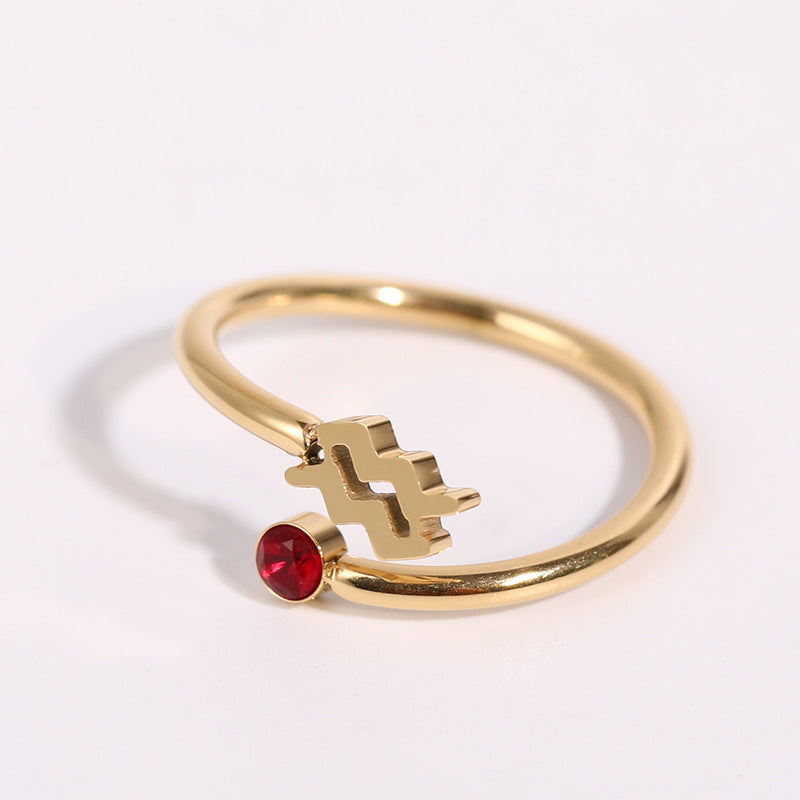
That illustrates an important point: reducing size complexity does not eliminate assortment complexity. Twelve zodiac variants create a different question—how many symbols should the retailer test?
Gemstone and Stone-Set Rings
Color and stones are reasonable areas for shallow testing, but the retailer still needs to learn whether customers respond to the exact color, stone description, price, and size structure offered.
Statement Rings
Statement rings can improve visual variety and help a retailer test bolder demand.
They should not automatically receive deep inventory simply because they photograph well or fit a trend report.
The practical rule is:
trend evidence earns a product a place in the test pool; store-level performance earns it a reorder.
Where Can Small Retailers Get Cheap High-Quality Rings?
The lowest listed wholesale price is not automatically the lowest cost to sell.
A retailer should think in terms of the cost of a sellable unit: product cost, size fragmentation, unsold variants, defects, shipping, fees where applicable, markdowns, and return or replacement friction.
AccsWholesale states that shipping is calculated at checkout, so this guide does not insert a fictional fixed shipping charge into the examples.
Consider two merchandise-only scenarios.
If a retailer buys a verified $3.32 adjustable ring and hypothetically retails it for $12:
$12.00 − $3.32 = $8.68
That is only a merchandise spread. It is not a promised gross margin because shipping, payment fees, packaging, taxes, returns, and other costs have not been included.
If the retailer buys a $14.01 S925/moissanite product and hypothetically retails it for $35:
$35.00 − $14.01 = $20.99
The second product has a larger merchandise spread, but it also requires more than four times as much merchandise capital per unit. The retailer still needs to ask how quickly each product sells, how many sizes must be carried, how much cash remains trapped in slower variants, what markdowns are required, and whether the winning SKU can be replenished.
A cheap ring that does not sell is not efficient inventory.
A more expensive ring that turns quickly can be commercially stronger.
The relevant question is how efficiently the SKU converts inventory capital into sellable, reorderable demand.
A $200 Merchandise-Only Wholesale Ring Test
A first order can be treated as a learning experiment rather than a prediction.
The following model uses only verified AccsWholesale product prices. It is hypothetical and is not a universal recommended allocation.
10 plain stainless steel units at $0.37 = $3.70
6 adjustable stainless steel units at $3.32 = $19.92
6 zodiac birthstone units at $2.33 = $13.98
6 stainless steel rotation rings at $2.11 = $12.66
4 S925/moissanite rings at $14.01 = $56.04
2 black moissanite S925 rings at $23.88 = $47.76
1 geometric zircon ring at $28.31 = $28.31
Total merchandise cost: $182.37
Remaining from the $200 merchandise budget: $17.63
That remainder is not labeled “shipping money” because actual shipping is calculated at checkout.
The model shows why different material tiers should not receive identical depth.
Ten units of the $0.37 base-priced ring use $3.70 in merchandise capital.
Four units of the $14.01 ring use $56.04.
Two units of the $23.88 ring use $47.76.
One $28.31 product represents the merchandise cost of more than 76 units at a $0.37 base price.
Those products are not interchangeable. Lower-cost products can make broader testing financially easier, while higher-cost silver and stone-set products may deserve shallower tests until the retailer has customer evidence.
That is the central assortment principle:
Use breadth to learn; use depth after evidence improves.
How Many Wholesale Ring Styles Should a Small Retailer Buy First?
There is no VERIFIED universal number of ring styles that every small retailer should buy.
Independent AI research performed during planning repeatedly produced specific starter quantities and percentage mixes, but those numbers were discovery signals, not verified facts, so they are not used as rules here.
What the verified evidence supports is the broader logic of shallow testing under uncertainty.
Faire’s 2026 ring guide reports more than 11,000 brands and more than 240,000 ring products in its marketplace, including products with MOQs as low as one unit. Faire also reports shallow per-style buying patterns for several retailer types within its own marketplace data.
Those figures should stay within their source context. They do not establish a universal inventory formula.
For a small retailer, a more transferable method is to build the first assortment around commercial roles: a lower-cost everyday tier, an adjustable tier, a silver tier, a stone-set or gemstone tier, and one or more visually distinctive test styles. Then use size sales, material-tier performance, discounting, defects or returns, cross-selling, and reorder availability to decide the next purchase.
What Is the Best Wholesale Jewelry Website for Buying Rings?
There is no single best wholesale jewelry website for every retailer because different sourcing routes solve different problems.
This is a supporting supplier question, not the starting point of the article. Product strategy comes first.
AccsWholesale: Direct Ready-Made Catalog
AccsWholesale represents a direct ready-made catalog in this comparison.
Its verified ring product pages provide fields such as price, MOQ, material, weight, size or variant information, and product images. Several examples used in this guide have MOQs of one or two units.
That structure can suit a retailer building a mixed-SKU test. For this topic, the relevant destination is the dedicated wholesale rings collection.
Faire: Multi-Brand B2B Marketplace
Faire represents a multi-brand marketplace model.
Its 2026 wholesale ring guide reports more than 11,000 brands and more than 240,000 ring products in its marketplace, with some products offering MOQs as low as one unit.
That model is useful when a retailer values brand breadth and comparison across many suppliers.
Terms can differ by brand, so marketplace scale does not remove the need to compare individual product and opening-order requirements.
Asonsteel: Direct Stainless-Steel Supplier Benchmark
Asonsteel provides a direct-supplier comparison for stainless-steel rings.
One verified Asonsteel ring listing used in the evidence set lists a $4.20 price, MOQ starting at 12, 304 stainless steel, zircon, PVD/18K gold-plated construction, and several size options.
That creates a different test commitment from an MOQ-1 SKU.
The useful comparison is not simply unit price, but how much capital the supplier requires before the design can be tested.
Shrum & Cooper / WholesaleSterling: Sterling-Silver Specialist
Shrum & Cooper, operating the current WholesaleSterling.com site, represents a specialist sterling-silver route.
Its official wholesale FAQ states that there is no minimum purchase amount and that merchandise is sold by the piece.
That makes it a useful comparison when a retailer is considering a more concentrated sterling-silver assortment rather than a broad fashion-jewelry catalog.
Alibaba: Manufacturer and Larger Sourcing Marketplace
Alibaba represents another sourcing route.
Its official Buyer Central describes a marketplace connecting buyers with manufacturers, wholesalers, and distributors and provides tools including RFQs, samples, supplier assessment, Ready to Ship products, and customization workflows.
That model can become relevant after a retailer has a clearer idea of what it wants to source and is evaluating factory, customization, or larger-volume options.
Choose the wholesale jewelry supplier or marketplace whose ordering model matches the product decision already made.
What Should Retailers Verify Before Ordering Wholesale Rings?
Retailers should verify the exact product claim before building inventory or customer-facing copy around it.
The FTC Jewelry Guides emphasize truthful representation of jewelry characteristics including type, quality, metallic content, size, weight, treatments, and related claims.
Verify the Metal
Do not assume a ring is sterling silver because it is silver-colored.
Do not infer the metal from the stone.
Use the exact product page.
Verify the Stone Description
CZ, zircon, moissanite, opal, and other stone terms should not be substituted for one another.
Use the supplier’s actual description.
Verify the Size Structure
Fixed and adjustable rings create different inventory obligations.
A fixed-size design should be evaluated by the number of sizes the retailer realistically needs to carry.
Verify MOQ at the Correct Level
Overall order minimums, per-style MOQs, and variant-level quantity rules are different constraints.
For the verified AccsWholesale zodiac ring, the product description states a Minimum Quantity of 2, even though a selector can display a different variant-level minimum. This guide therefore uses the product-description MOQ 2.
Verify Weight and Variants Where Available
Verify Shipping Separately
AccsWholesale calculates shipping at checkout.
Do not convert merchandise price into “landed cost” until the order’s real shipping and other transaction costs are known.
Verify Reorderability
An attractive first order is more useful when a winning SKU can be replenished.
Reorderability belongs in the buying decision before a retailer commits deeper inventory.
Use Customer Evidence to Decide What Gets Reordered
A first wholesale ring order should reduce uncertainty. After the test, evaluate products by more than raw unit sales.
Sell-through: Did the ring actually move?
Size performance: Which fixed sizes sold and which remained?
Material tier: Did customers accept the intended stainless steel or silver price position?
Price acceptance: Did the product sell at the planned retail price or only after discounting?
Defects and returns: Did a specific construction create problems?
Cross-selling: Did stackable, complementary, or gift-oriented rings sell together?
Reorderability: Can the same SKU be sourced again?
A March 2026 r/ecommerce discussion illustrates why this matters. A jewelry entrepreneur described how size-specific MOQ requirements could quickly multiply the cash needed to launch a ring assortment.
That discussion is anecdotal. It does not establish an industry-average MOQ.
But the inventory mechanism is real and easy to model:
more designs × more sizes × more units per size = more opening inventory
The purpose of the first order is to produce enough evidence to make the second order better.
Frequently Asked Questions About Wholesale Rings for Small Retailers
What are the best wholesale rings for a small boutique?
The strongest starting assortment usually combines several commercial roles instead of relying on one style. Adjustable rings can reduce sizing complexity, stainless steel can provide a lower-cost test tier, and sterling silver or stone-set rings can provide a higher-value tier. The right mix depends on the boutique’s customers, target retail prices, and size demand.
Are adjustable rings better for small retailers?
Adjustable rings can be especially useful when a retailer has limited size-history data because they reduce fixed-size fragmentation. They are not automatically better for every store. A retailer with reliable size-level sales data may be able to manage fixed sizes efficiently.
Are wholesale sterling silver rings better than stainless steel rings?
Neither material is universally better. Stainless steel can support lower-cost testing, while sterling silver can support a higher-value assortment. The relevant comparison is how much capital each SKU requires, how many sizes must be carried, and whether customers support the intended retail price.
Are wholesale sterling silver rings with stones worth buying?
They can be worth testing when a retailer wants a more differentiated or higher-priced ring tier. Buyers should verify the exact metal field, stone description, sizes, MOQ, weight, and product cost. Higher unit costs generally make a shallow first test more defensible when demand is still uncertain.
Where can I get cheap high-quality wholesale rings?
Compare more than unit price. Consider material, sizing structure, MOQ, shipping, defects, unsold variants, and reorderability. Direct catalogs such as AccsWholesale, marketplaces such as Faire, specialist wholesalers such as Shrum & Cooper, direct suppliers such as Asonsteel, and manufacturer marketplaces such as Alibaba represent different sourcing models.
What is the best wholesale jewelry website for buying rings?
There is no universal best website. AccsWholesale represents a direct catalog, Faire a multi-brand marketplace, Shrum & Cooper a sterling-silver specialist, Asonsteel a direct stainless-steel supplier, and Alibaba a manufacturer and larger-sourcing marketplace. The appropriate route depends on material, quantity, assortment strategy, and whether the buyer needs ready-made inventory or broader sourcing tools.
How many ring sizes should I stock?
There is no universal verified number. Use actual customer-size data where possible. If size demand is uncertain, keep fixed-size depth conservative and use adjustable styles where they fit the assortment while gathering data about which sizes actually sell.
Should I buy trending rings in bulk?
Trend reporting is better used to select products for testing than to justify a deep order. Current 2026 reporting supports attention to color, gemstones, birthstone concepts, personalization, and expressive designs, but those signals do not prove a particular ring will sell in a specific store.
What should I check before placing a wholesale ring order?
Verify the exact material, stone description, size structure, weight where provided, MOQ, variant pricing, shipping terms, and reorder path. Do not infer purity, stone identity, availability, or landed cost from a photograph or product title alone.
What Are the Best Wholesale Rings for Small Retailers Overall?
The best wholesale rings for small retailers are the rings that make customer demand affordable to test.
Start with sizing risk. Decide where adjustable rings can reduce inventory fragmentation and where fixed-size products are justified by real customer data.
Then build a material ladder. Lower-cost stainless steel can support broader experimentation, while sterling silver and stone-set silver should usually receive more selective opening inventory because each unit consumes more capital.
Use current trends to decide what deserves attention—not what deserves a deep order. Use supplier type only after the product strategy is clear. Then use sell-through, size performance, defects, price acceptance, and reorderability to determine where inventory depth should increase.
For retailers ready to compare actual products, AccsWholesale’s wholesale rings collection can serve as the next step from research to SKU-level evaluation.
Compare Wholesale Rings With Real Product Data
Compare ring materials, sizing structures, MOQ, prices, and product variants before deciding which styles deserve a deeper order.
Explore Wholesale RingsRelated Posts

Where to Buy Badge Reels: Online & Bulk Supplier Guide
This guide explains where retailers and bulk buyers can source badge reels online by matching reel type, order size, customization...
Read More
What Is the Best Wholesale Jewelry Website? Retailer Supplier Guide
This guide compares wholesale jewelry websites for retailers based on sourcing model, product transparency, assortment fit, and replenishment needs. It...
Read MoreInvalid password
Enter