




Access Denied
IMPORTANT! If you’re a store owner, please make sure you have Customer accounts enabled in your Store Admin, as you have customer based locks set up with EasyLockdown app. Enable Customer Accounts

How to Make Keychains With Beads: Supplies & 3 Easy Methods
Posted By AccswholesaleBlog
on

The easiest way to learn how to make keychains with beads is to choose the construction method before you choose the beads. Three practical methods cover most of the decisions a beginner needs to understand: string or cord, beading wire with crimps, and a metal beadable bar or blank.
For a basic cord keychain, you need beads, cord, keychain hardware, scissors, and a secure finishing method. A wire design uses beading wire and crimps instead of relying on a cord knot. A beadable-bar keychain works differently again: the beads slide directly onto a rigid metal bar that is opened and then secured back into the keychain. Cara & Co.'s beadable-bar tutorial demonstrates that unscrew → add beads → reattach sequence on its own bar system.
The key rule is not to assume that every bead works with every method. Check the bead hole against the cord, wire, or metal bar you plan to use. Beadable Bliss, for example, explicitly warns that non-silicone beads may or may not fit its particular sticks, showing why compatibility needs to be checked product by product rather than assumed.
If you are making keychains to sell, learn and test the construction first. Only after you know which components work together should you compare suppliers, marketplaces, beadable blanks, pack sizes, MOQ, or component costs.
Key Takeaways for Making Keychains With Beads
- Start by deciding whether you are making a string or cord keychain, a wire-and-crimp keychain, or a beadable-bar keychain.
- Beads and keychain hardware are common to many designs, but the structural material and finishing method change.
- Cord designs generally depend on a secure knot or cord finish; wire designs use crimps; bar-style blanks hold beads directly on a rigid metal component.
- A bead's outside diameter does not prove that it will fit. The bead hole still has to match the chosen cord, wire, or bar.
- Letter beads, focal-style beads, spacers, charms, and color patterns should be added only after the underlying construction works.
- Small sellers should compare supplier type, MOQ, pack quantity, component breadth, price, and available specifications rather than judging a source by the lowest displayed price alone.
- AccsWholesale currently carries low-MOQ beadable keychain bars and multiple bead products, but compatibility between individual SKUs should not be assumed without matching specifications.
What You Need to Make Beaded Keychains
The exact shopping list depends on the method, but most beaded keychains involve four categories: beads, a structural material, keychain hardware, and any tools needed to finish that structure.
Beads
Possible bead types include pony beads, letter beads, acrylic beads, silicone beads, glass beads, focal-style beads, and spacers. Appearance matters, but it should come after fit.
AccsWholesale currently lists a 100-piece pack of 15 mm silicone beads under SKU ACC-BDS-JIaHao004 for $9.33, with MOQ 1, silicone material, and a listed weight of 200 g. View the 15 mm silicone beads.
It also lists a 50-piece pack of 20 mm acrylic beads under SKU ACC-BDS-NiJia012 for $8.90, MOQ 1, acrylic material, and a listed weight of 300 g.
Those outside bead dimensions are useful product facts, but they do not establish that either product fits a specific beadable bar. A bead's outside diameter and its hole diameter answer different questions.
Structural Material
This choice determines the method:
- String or cord creates a flexible keychain that is normally finished with a knot or another cord-specific connection.
- Beading wire creates a wire-strung design that can be secured with crimps.
- A metal beadable bar or blank carries the beads directly on the rigid bar.
Choosing this structure first prevents you from buying decorative components that cannot be assembled the way you intended.
Keychain Hardware
The hardware may include a split key ring, lobster clasp, swivel attachment, jump ring, or a ring and clasp already built into the beadable blank.
The hardware does not need to be identical across all three methods. What matters is whether the chosen structure can be secured to it reliably.
Finishing Tools
Cord designs may require only scissors and the tools appropriate to any charms or jump rings. Wire projects require a crimp system and suitable pliers. In Fire Mountain Gems' professional crimping tutorial, crimping pliers are used to close a crimp bead; in a separate crimp-tube method, chain-nose pliers are used instead. The correct tool therefore depends on the specific crimping system rather than one universal rule.
For some beadable-bar designs, no string or wire is required at all. Cara & Co.'s example is opened by unscrewing the bar, adding beads, and twisting the bar back into place.
Choose the Right Construction Method First
A better beginner question is not simply “Which beads should I buy?” It is: How will these beads actually be held on the keychain?
| Method | Main Structure | Typical Finish | First Compatibility Question |
|---|---|---|---|
| String / Cord | Flexible cord through bead holes | Knot or cord-specific finish | Will the cord pass through the beads in the required strand arrangement? |
| Wire + Crimps | Flexible beading wire | Crimped connection | Do the beads, wire, crimps, and hardware work as one system? |
| Beadable Bar / Blank | Rigid metal bar | Bar or end closure | Will the bead holes fit over this specific bar and still leave room to close it? |
None of these methods needs to be treated as universally superior. They are different construction systems.
Method 1: How to Make a Keychain With Beads and String or Cord
For a beginner, the cord method is easy to understand visually: the beads are threaded onto a flexible strand, and the strand is secured to keychain hardware.
Step 1: Plan the Design
Lay out the beads before threading them. This is especially useful for names, alternating colors, focal arrangements, or symmetrical patterns.
If you are spelling a name with letter beads, confirm the order before you start. Correcting a letter after the finishing knot has been completed creates unnecessary rework.
Step 2: Test the Bead Holes
Pass the selected cord through a sample bead before building the whole keychain.
If the design requires two strands to pass through the same bead, test both strands together. The r/Beading discussion used in this guide illustrates exactly this kind of beginner uncertainty: choosing “string” is not enough without understanding how the cord and bead opening interact.
Step 3: Attach the Cord to the Keychain Hardware
A cord design can use a looped attachment or another secure connection suited to the chosen cord and hardware. Keep the working area visible until you have confirmed the connection is secure.
The important point is not that every cord keychain must use one exact knot. The important point is that the attachment method needs to match the cord and hardware you actually selected.
Step 4: Add the Beads
Thread the beads in the planned order.
For a name keychain, the letters may form the center of the design. For a decorative design, one larger or shaped bead can become the visual focus while simpler beads or spacers organize the surrounding pattern.
Step 5: Secure the End
Finish the cord with a knot or other connection appropriate to that cord. Do not trim immediately against an untested knot.
Complete the connection first, test it, and then trim the excess.
Step 6: Test the Finished Keychain
Pull on the strand and inspect the connection to the key ring before treating the keychain as finished.
For a seller, repeatability also matters. A design that works once but is difficult to reproduce consistently is not yet a reliable production method.
Method 2: How to Make a Beaded Keychain With Wire and Crimps
Wire changes the finishing system. Instead of tying the strand in the same way as a cord design, the wire can be secured to hardware with a crimp.
Fire Mountain Gems' professional instructions demonstrate the core mechanism: beading wire passes through a crimp and a clasp or other finding, returns through the crimp, and is then compressed to secure the connection. One of its tutorials uses crimping pliers, while another crimp-tube method uses chain-nose pliers. See the professional crimping tutorial.
Step 1: Match the Components
The beads must accept the wire. The crimp must be appropriate for the wire system, and the hardware must provide a usable attachment point.
The relationship is:
bead → wire → crimp → hardware
A problem at one connection can make the rest of the assembly unusable.
Step 2: Plan the Bead Order
Lay out the beads before making the permanent finishing connections.
Wire is particularly useful when you want a defined strand and a jewelry-style crimped finish rather than a visible cord knot.
Step 3: Form the Hardware Connection
Following the relevant crimp system, pass the wire through the crimp and hardware and route it back through the crimp as required.
Fire Mountain's Accu-Flex tutorial demonstrates this with a crimp tube and clasp connection.
Step 4: Compress the Crimp
Use the tool appropriate to that particular crimp system. Do not assume that flattening any crimp with any plier creates a secure connection.
Step 5: Test the Connection
Fire Mountain's instructions specifically include pulling on the wire to check that the connection is secure and recompressing it if movement remains. That is a useful finishing principle for a wire-strung keychain as well.
Method 3: How to Make a Keychain With Beads Using a Beadable Bar or Blank
A beadable bar is structurally different from the first two methods. There is no long strand of cord to knot and no wire strand to crimp. Instead, the decorative beads slide onto the metal bar itself.
Cara & Co.'s tutorial demonstrates the process directly: unscrew the bar, line up the chosen beads on the bar, and twist the bar back into the keychain.

Step 1: Identify How the Blank Opens
Before forcing a component, find the removable or openable end.
Different products may use different closures, so the exact opening method should come from the product design rather than an assumption based on another supplier's blank.
Step 2: Check the Bead Hole Against the Bar
This is the most important compatibility check in the bar-style method.
Beadable Bliss warns on one of its metal bar products that non-silicone beads may or may not fit its sticks. That is supplier-specific wording, but it supports a broader purchasing principle: visual similarity does not establish physical compatibility.
Cara & Co.'s Premium Beadable Bar Keychain, for example, lists a 2 mm bar diameter and a 60–65 mm bar length for that specific product. Those numbers are useful for that Cara product only. They are not an industry-wide standard and should not be transferred to an AccsWholesale bar without equivalent specifications.
Step 3: Test the Layout
Slide the planned beads and spacers onto the bar without forcing them.
The arrangement also needs to leave enough usable space for the bar to close again. A bead that fits onto the bar can still be unsuitable for a particular arrangement if the finished layout prevents the closure from engaging.
Step 4: Re-Secure the Bar
Close the bar according to that product's construction. Cara's tutorial uses a twist-back closure for its system.
Step 5: Test One Finished Unit Before Repeating It
If you plan to make several identical keychains, the first completed sample should verify the component combination before you commit more inventory.
AccsWholesale currently lists several low-MOQ metal beadable keychain products. ACC-KC-BF006 is listed at $1.04, MOQ 1, 20 g, and metal construction.
ACC-KC-HuaH008 is listed at $0.99, MOQ 2, 15 g, and metal construction.
Those are useful low-quantity product examples, but neither page provides the dimensional evidence needed to claim that a particular Accs bead SKU is compatible with those bars.
Which Beads Work With Each Method?
The safest answer is: use beads whose holes fit the construction system and whose design suits the finished keychain.
Material or outside diameter alone is not enough.
Pony and Letter Beads
Pony and letter beads are natural choices for simple color patterns and name designs when their holes accept the cord or other structure being used.
This guide intentionally does not expand into animal, lizard, or woven pony-bead pattern instructions. Those are separate bead-weaving searches and would pull the article away from its main question: how to choose and assemble a beaded-keychain construction.
Silicone Beads
Silicone beads are present across the beadable-product sourcing environment, and AccsWholesale currently lists a verified 15 mm silicone-bead pack among its broader beads for DIY projects.
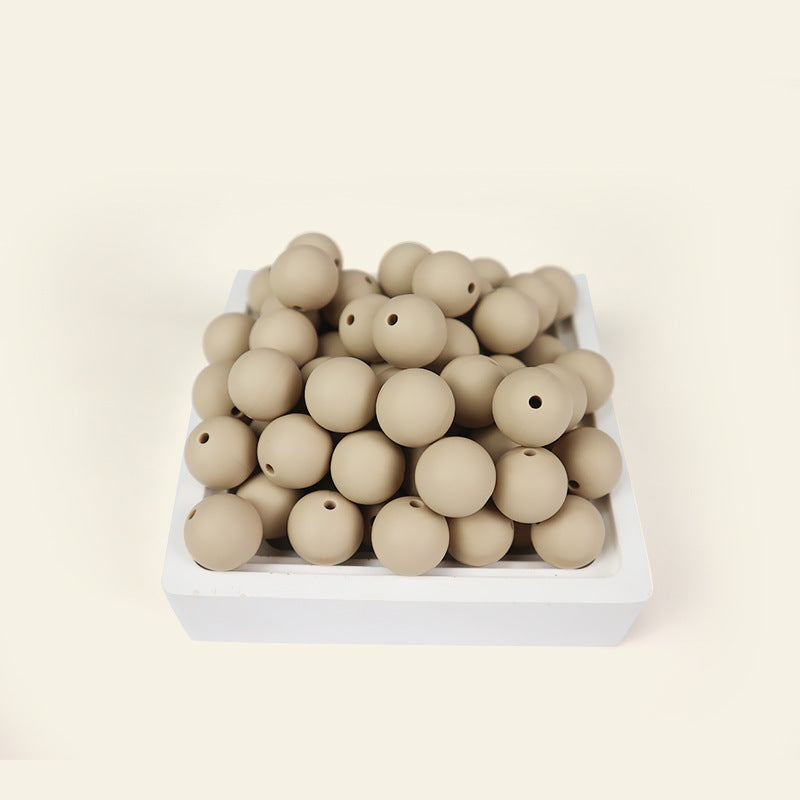
The 15 mm figure describes the bead's listed outside size. It does not establish the hole diameter, so it should not be used as proof that the bead fits a specific keychain bar.
Acrylic Beads
AccsWholesale's verified 20 mm acrylic-bead pack provides another useful example: 50 pieces, acrylic material, $8.90, MOQ 1, and 300 g listed weight.

Again, these fields describe the product itself. They do not establish compatibility with an unrelated bar SKU.
Spacer Beads
Spacers can separate larger beads, frame a focal element, or change the rhythm of a design. AccsWholesale currently lists ACC-BDS-ZiGe001 as a 50-piece iron spacer-bead pack with 6 mm and 8 mm variants, MOQ 1, 50 g listed weight, and a current price of $2.07.

At that pack price, the arithmetic is:
$2.07 ÷ 50 = $0.0414 per spacer
That is a component-cost calculation, not a compatibility claim.
Check Component Compatibility Before You Buy in Quantity
Compatibility is part of the purchasing decision, not just an assembly detail.
For a cord design, check whether the bead hole accepts the required strand arrangement and whether the cord can be secured to the hardware.
For a wire design, check the relationship between the bead opening, wire, crimp, and hardware.
For a beadable-bar design, check whether the bead hole passes over that exact bar and whether the selected bead arrangement leaves enough usable space to close it.
Three shortcuts should be avoided:
Do not use outside bead diameter as a substitute for bead-hole diameter.
Do not use one supplier's bar diameter as a universal standard.
Do not assume products are compatible simply because both are labeled “beadable.”
That compatibility-first approach is one of the most important differences between making one decorative sample and purchasing components for repeat production.
Easy Design Variations: Names, Focal Beads, Spacers, and Charms
Once the structure has been tested, customization becomes much easier.
Name Keychains
Arrange letter beads before assembly and confirm the spelling before making the final connection. Build color or spacer choices around the word rather than trying to insert the letters after the keychain has been finished.
Focal Designs
A larger or shaped bead can become the visual center of the design. Supporting beads can remain simpler so the focal element remains clear.
Spacer Designs
Spacers create separation and can help organize color blocks or focal elements. On a bar-style keychain, they also consume usable bar length, so they should be included in the test layout before the bar is closed.
Charms
Charms can be added through suitable hardware such as jump rings when the construction provides an attachment point. A charm is a design variation, not a substitute for a secure structural connection.
Personalized and decorative bag accessories are still visible in 2026 fashion coverage. ELLE, for example, published a 2026 feature centered on the continuing use of bag charms and wearable accessories attached to bags. This is useful context for personalization, but it is not evidence that beaded-keychain demand itself is growing at a particular rate.
Common Beginner Mistakes
Mistake 1: Buying Beads Before Choosing the Method
A bead can look right and still be wrong for the cord, wire, or bar.
Better approach: decide how the keychain will be constructed before buying a large bead assortment.
Mistake 2: Assuming One Bead Size Is Universal
This guide has no verified evidence for one universal “keychain bead size.”
Better approach: use product-specific hole and bar information when it is available.
Mistake 3: Treating String and Wire as the Same Technique
A knotted cord connection and a crimped wire connection are different finishing systems.
Better approach: use the finishing method intended for the structural material.
Mistake 4: Forcing Beads Onto a Bar
If a bead does not move over the bar normally, forcing it does not solve the compatibility problem.
Better approach: stop and verify the dimensions before building the design.
Mistake 5: Skipping a Finished-Sample Test
A sample should be checked before the same component combination is repeated across inventory.
Better approach: inspect the hardware connection, closure, strand, and overall repeatability before scaling the design.
Where Can Small Sellers Buy Beads and Beadable Keychain Blanks?
Only after the construction and compatibility questions are solved does sourcing become the main decision.
Small sellers can use several routes, and they solve different problems. The useful comparison is not “Which supplier is universally best?” It is which sourcing route fits the components, order size, and verification level you need.
Specialist Bead Supplier: Raebe
Raebe describes itself as serving both individual crafters and wholesale buyers. Its official site currently states that it has no minimum order, requires no account sign-up, and offers bulk pricing tiers across bead and keychain collections.
That makes it relevant as a specialist supply route when a buyer wants to compare bead categories and component options without committing to one large opening order.
These are Raebe's own published commercial terms, not an independent ranking of its value against other suppliers.
Maker Marketplace: Etsy
Etsy is a marketplace rather than one supplier. Its verified Blank Keychains Bulk marketplace page currently contains beadable bars, metal keychain blanks, and listings with different quantity formats from independent sellers.
That makes Etsy useful as a route for comparing specialized sellers and pack structures. Price, material, dimensions, MOQ, shipping, and quality still need to be checked listing by listing rather than assigned to Etsy as a whole.
Wholesale Marketplace: Faire
Faire represents a different sourcing model: multi-brand wholesale discovery.
Its beadable-keychain discovery environment currently includes products from multiple brands, including Cara & Co., along with other keychain and bead suppliers.
That makes Faire useful when a retailer wants to compare wholesale brands within one marketplace environment. It does not mean every Faire listing has the same MOQ, price, or specifications.
Beadable Specialist: Beadable Bliss
Beadable Bliss combines beadable items with bead-focused supplies. Its verified metal beadable-keychain product page offers several quantity tiers and, more importantly for this guide, explicitly warns buyers that non-silicone beads may or may not fit its sticks.
The article does not use that warning to rank Beadable Bliss. It uses it as a concrete example of why supplier-specific compatibility information matters.
General Craft-Retail Route: Michaels
Michaels currently lists an 18-pack beadable-keychain-bar product under Item #594257795978035211.
This establishes general craft retail as another sourcing route for a packaged set of beadable bars. It does not establish that Michaels is cheaper or better than a specialist or wholesaler.
Low-MOQ Wholesale Component Route: AccsWholesale
AccsWholesale fits a different role from a pure bead specialist or a multi-seller marketplace. Its broader beadable keychains landing route sits within the site's “Other Beadable items” collection, which currently includes multiple metal beadable keychain bars alongside other beadable products.
The same site also has a separate bead collection containing silicone, acrylic, spacer, and other bead products.
Verified current examples include:
- ACC-KC-BF006 — $1.04, MOQ 1, metal, 20 g
- ACC-KC-HuaH011 — $0.53, MOQ 2, metal, 6 g
- ACC-KC-HuaH008 — $0.99, MOQ 2, metal, 15 g
- ACC-BDS-JIaHao004 — 100 silicone beads, $9.33, MOQ 1
- ACC-BDS-NiJia012 — 50 acrylic beads, $8.90, MOQ 1
- ACC-BDS-ZiGe001 — 50 iron spacer beads, $2.07, MOQ 1
The bar-product fields are supported by current Accs product pages. The bead-product fields are likewise based on current product pages.
These details make Accs useful for low-quantity cost modeling and sourcing examples. They still do not prove that every listed bead fits every listed keychain bar.
A Simple Small-Batch Costing Example
Costing should begin with verified pack prices and quantities, but compatibility needs to be confirmed separately before products are combined into a real design.
From the verified Accs data:
15 mm silicone beads:
$9.33 ÷ 100 = $0.0933 per bead
20 mm acrylic beads:
$8.90 ÷ 50 = $0.178 per bead
Wave spacer beads:
$2.07 ÷ 50 = $0.0414 per spacer
ACC-KC-BF006 beadable bar:
$1.04 per listed unit at MOQ 1.
Suppose a maker has already independently confirmed that a particular tested design can use the relevant bar, five beads from the $9.33 pack, and two spacers from the $2.07 pack.
5 × $0.0933 = about $0.47 in beads
2 × $0.0414 = about $0.08 in spacers
$1.04 + $0.47 + $0.08 = about $1.59
This is an illustrative costing method only. It is not evidence that ACC-KC-BF006 is compatible with ACC-BDS-JIaHao004 or ACC-BDS-ZiGe001.
A real finished-cost worksheet would still need to add whatever other costs actually apply to that business, such as additional hardware, charms, packaging, labor, shipping, defects, or transaction costs.
A Better Purchasing Sequence for Small Sellers
1. Choose the construction method.
Decide whether the design uses cord, wire, or a beadable bar before buying large quantities of decorative components.
2. Test compatibility.
Use enough components to prove that the bead holes, structural material, hardware, and finish work together.
3. Record the exact combination.
Keep the supplier, SKU or listing, material, relevant dimensions, color, pack quantity, and finishing method attached to the successful sample.
4. Calculate the component cost.
Convert pack prices into per-piece costs and multiply by the quantity actually used.
5. Test repeatability.
Make the design again. If it cannot be reproduced consistently, the sourcing decision is not finished.
6. Compare sourcing routes.
A specialist supplier, maker marketplace, wholesale marketplace, craft retailer, and low-MOQ wholesale source each solve different purchasing problems.
7. Scale only the combinations you have verified.
A lower per-piece price does not compensate for incompatible beads or unusable blanks.
FAQ
What supplies do I need to make a beaded keychain?
You need beads, a structure to hold them, keychain hardware, and any tools required for that structure. Cord designs use cord and a secure cord finish. Wire designs add crimps and suitable pliers. Bar-style blanks hold the beads directly on a rigid component.
What string is best for beaded keychains?
There is no single verified string that is best for every beaded keychain. Choose cord according to the bead-hole size, the strand arrangement, the finishing method, and the intended construction. Test the combination before making multiple units.
Can I use elastic cord for a keychain?
Elastic cord appears in beginner beading methods, but it should not be treated as universally suitable. The cord still needs to fit the beads and provide a finishing method appropriate to the intended use.
How do I make a keychain with beads and wire?
Use beading wire that passes through the selected beads, connect it to the keychain hardware through a suitable crimp system, compress the crimp with the tool required by that system, and test the finished connection. Fire Mountain's tutorials demonstrate both crimping-plier and chain-nose-plier methods for different crimp systems.
What is a beadable keychain blank?
A beadable keychain blank is a base designed to accept decorative beads. In a bar-style design, the beads slide directly onto an openable or removable metal bar. Cara & Co.'s tutorial demonstrates an unscrew-add-resecure construction on its own beadable-bar system.
What size beads should I use for a beadable keychain?
Do not rely on one universal outside bead size. Check the bead hole against the exact cord, wire, or bar you are using. One supplier's published bar diameter should not be assumed to apply to another supplier.
Can I make beaded keychains with names?
Yes, when the selected letter beads fit the construction method. Arrange the spelling before assembly and then build the rest of the color or spacer pattern around it.
Can I add charms to a beaded keychain?
Yes, when the hardware provides an appropriate attachment point. Add the charm only after the underlying keychain structure has been secured.
Where can small sellers buy beadable keychain blanks?
Verified sourcing routes include specialist bead suppliers such as Raebe, maker marketplaces such as Etsy, wholesale marketplaces such as Faire, beadable specialists such as Beadable Bliss, general craft retailers such as Michaels, and low-MOQ component suppliers such as AccsWholesale. The useful comparison is supplier type, MOQ, pack structure, specifications, and component fit—not a universal “best supplier.”
Should I buy beads and blanks in bulk immediately?
Not before the design is proven. Verify the construction, compatibility, repeatability, and component cost first. Then compare larger quantities for the specific components that have already worked in your design.
Final Answer
If you want to learn how to make keychains with beads, start with the construction method, not the bead color.
Use string or cord for a flexible, knot-finished design. Use beading wire with crimps for a wire-strung connection. Use a beadable metal bar or blank when the beads slide directly onto a rigid keychain component.
Then confirm the component relationship:
bead hole → cord, wire, or bar → finishing method → keychain hardware
Only after that system works should you add names, color patterns, focal designs, spacers, or charms.
For small sellers, sourcing comes afterward. Compare supplier type, MOQ, pack quantity, price, product specifications, and compatibility evidence. Specialist suppliers, marketplaces, wholesale platforms, general craft retailers, and low-MOQ wholesalers each solve different buying problems.
The practical decision path is:
Choose the method → verify compatibility → assemble and test → calculate component cost → source the proven components in the quantity the business actually needs.
Explore Beadable Keychain Components
Review current beadable keychain bars and related beadable items, then verify component fit before repeating or scaling a design.
Explore Beadable KeychainsResearch note: Product facts, supplier information, cited tutorials and user discussions were checked in September 2026. Reconfirm current price, MOQ, availability, shipping terms and external-source details immediately before publication or ordering.
Related Posts

How to Start a Hair Accessories Business: Costs, Products & Sourcing
Starting a hair accessories business is easier to manage when the first assortment is built around a clear customer, controlled...
Read More
Where to Buy Hair Accessories: Retail, Online & Wholesale Options
This guide explains where to buy hair accessories for personal use and resale, comparing mass retailers Target and Walmart, beauty-focused...
Read MoreInvalid password
Enter