




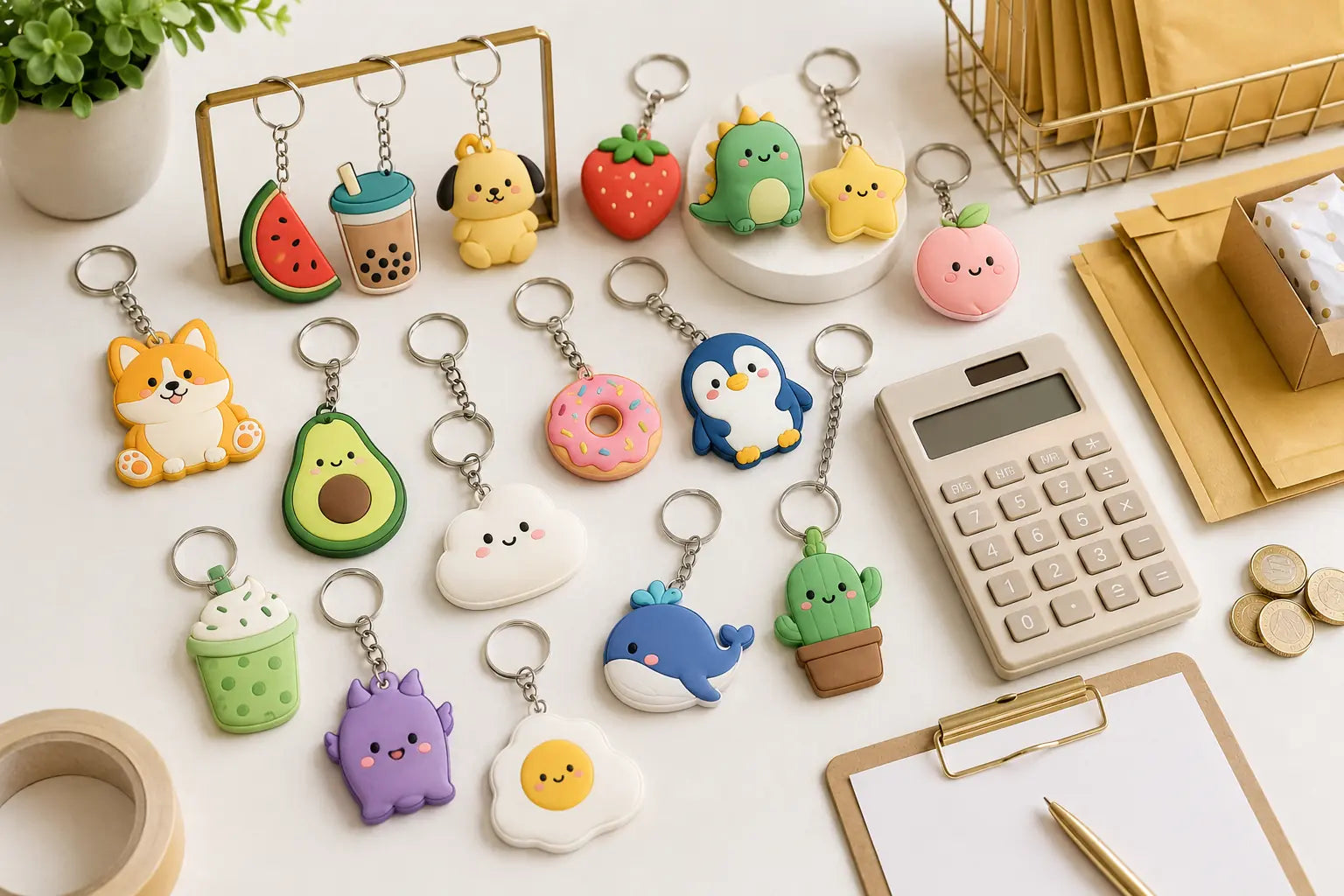
Yes, selling cartoon keychains can be profitable when a retailer controls landed cost, tests several designs in limited quantities and sells through channels that leave enough contribution after fees. A low supplier price can create room for a healthy margin, but packaging, inbound freight, payment or marketplace fees, advertising, shipping subsidies, returns, damaged units and unsold designs must be deducted before the business is described as profitable.
Key Takeaways About Selling Cartoon Keychains
- Cartoon keychains can support attractive unit economics because they are compact, relatively inexpensive to test and suitable for individual, bundle and add-on sales.
- Gross margin is not net profit because marketplace fees, packaging, advertising, shipping support, fixed expenses and unsold stock can materially reduce the result.
- Sell-through rate is as important as markup because a high-margin design cannot recover money tied up in inventory that does not sell.
- Small mixed-design tests reduce product risk because the seller can compare themes, materials and customer response before making a larger reorder.
- General cartoon-style products require different checks from famous-character merchandise because protected artwork, names, logos and character identifiers may create copyright or trademark risks.
Review note: The financial figures in this article are illustrative planning examples, not quotations or guaranteed earnings. Product availability, quantities, prices, marketplace charges and shipping costs can change, so every seller should replace the assumptions with current figures before buying inventory.
Are Cartoon Keychains Profitable?
Cartoon keychains are potentially profitable when the net contribution per sale and the percentage of inventory sold are both strong. Profitability depends less on the retail price alone than on three connected variables: complete landed cost, sell-through rate and sales-channel expenses. A keychain that appears inexpensive can still produce a weak result if it requires costly advertising or if much of the order remains unsold.
A cartoon keychain business is often strongest as a focused product line or extension to an existing assortment. Gift shops, accessory stores, bag sellers, market vendors and online retailers can use keychains as entry-price products, checkout add-ons or themed bundles. This model allows the business to share traffic, packaging and fulfillment resources with other products instead of requiring every low-value keychain to acquire a customer by itself.
A profitable test must measure real outcomes rather than rely on a theoretical markup. The seller should record landed cost, units received in sellable condition, units sold, selling fees, discounts, advertising expense and remaining inventory. The result provides a more defensible answer than simply subtracting a supplier price from a displayed retail price.
Financial Breakdown for a Cartoon Keychain Business
The financial breakdown should begin with the complete amount required to make inventory ready for sale. Inventory cost is only one component, while inbound freight, packaging, photography, platform setup and initial promotion may also require cash. The U.S. Small Business Administration startup-cost worksheet provides a structured way to organize startup expenses and assets.
How Much Does It Cost to Start Selling Cartoon Keychains?
A small cartoon keychains test can be planned with a limited budget, but there is no universal startup amount. The required cash depends on the number of designs, supplier terms, destination, inbound shipping, packaging, sales channel and marketing method. The following $280 model shows how a seller might organize a 100-unit test without representing an AccsWholesale quotation.
| Startup item | Illustrative calculation | Example cost |
|---|---|---|
| Initial inventory | 100 units × $1.20 | $120 |
| Inbound shipping | Estimated for the test | $35 |
| Retail packaging | 100 units × $0.20 | $20 |
| Photography and display materials | Estimated setup expense | $30 |
| Store or marketplace setup | Estimated setup expense | $25 |
| Initial promotion | Controlled test budget | $50 |
| Illustrative test budget | $280 | |
The test budget should be replaced with current, seller-specific numbers before an order is approved. A supplier page may show the product price but cannot automatically predict the final freight, local fees, payment costs or marketing expense for every buyer. A cash reserve may also be needed because revenue does not necessarily arrive before the next bill or reorder.
Cartoon Keychains Unit Economics and Profit Margins
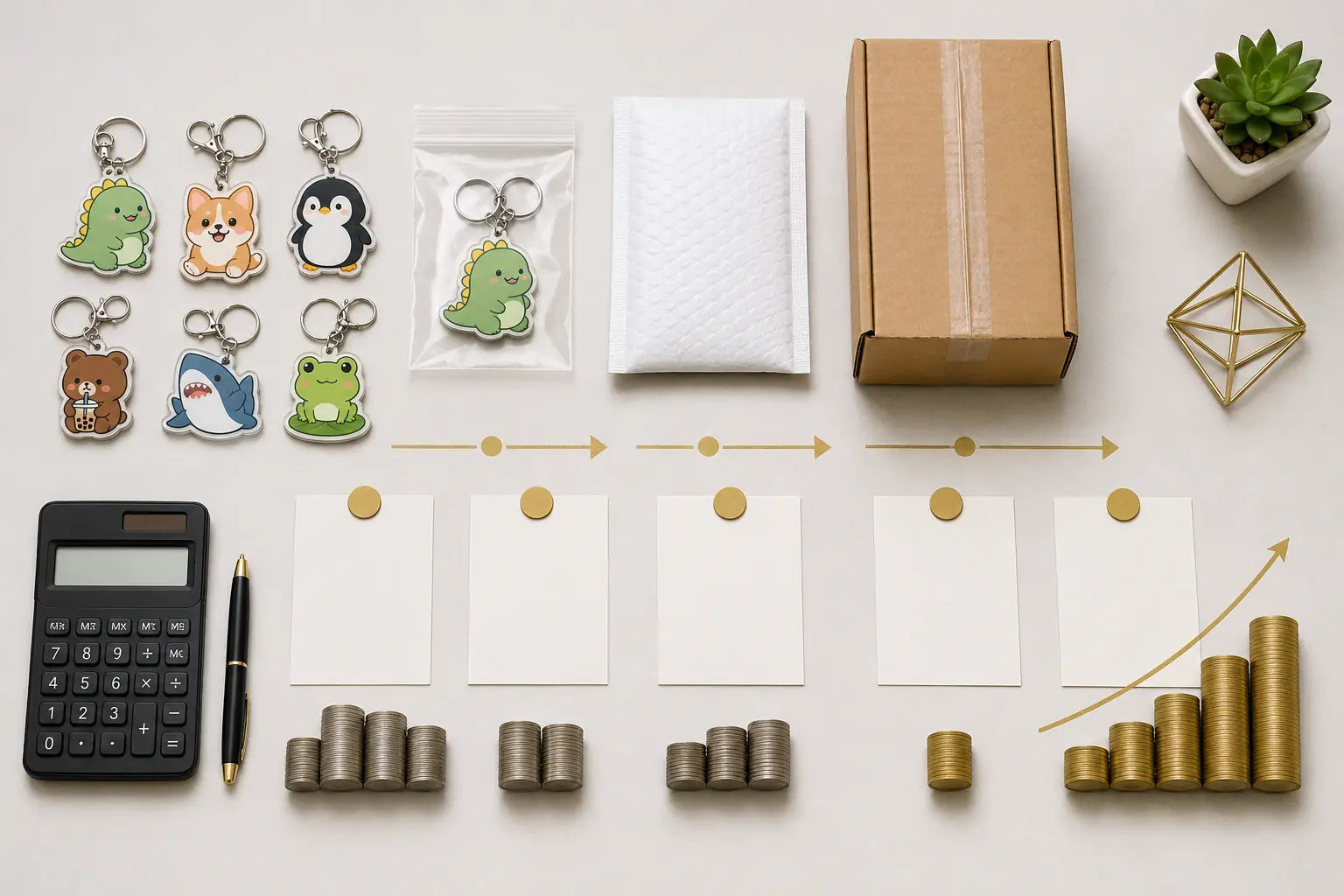
Net contribution per keychain is a more useful operating measure than the difference between retail and supplier prices. It estimates how much remains from a sale after the variable expenses required to generate and fulfill that sale. Fixed expenses, owner labor, software subscriptions and taxes may still need to be deducted later to determine final business profit.
Net contribution per keychain = selling price − landed product cost − packaging − selling fees − advertising cost per sale − shipping subsidy − expected loss allowance
An illustrative $6 sale can leave $2.40 in contribution when the stated assumptions are applied. This is a model for understanding the calculation, not a forecast of what a particular seller or product will earn.
| Unit-economics item | Illustrative amount |
|---|---|
| Selling price | $6.00 |
| Landed product cost | −$1.55 |
| Packaging | −$0.20 |
| Marketplace or payment fees | −$0.75 |
| Advertising allocation | −$0.60 |
| Shipping subsidy | −$0.40 |
| Expected damage, return or loss allowance | −$0.10 |
| Estimated net contribution | $2.40 |
The illustrative contribution margin is 40% because $2.40 divided by the $6 selling price equals 0.40. The percentage should not be described as guaranteed net profit because fixed overhead, labor and taxes have not been included. Sellers who need a broader foundation can also review Can I make money selling keychains? for a general keychain cost-and-profit framework.
Marketplace charges must be deducted before an Etsy listing is counted as profitable. Etsy’s official policy currently describes a 6.5% transaction fee on the displayed listing price plus amounts charged for shipping and gift wrapping, while listing, payment-processing, advertising, currency-conversion or country-specific charges may also apply. Sellers should verify the charges applicable to their account through Etsy’s official Fees & Payments Policy when creating a live calculation.
How Many Cartoon Keychains Must You Sell to Break Even?
The example business must sell approximately 117 units to recover a $280 startup budget when each sale produces $2.40 in contribution. The calculation divides the amount to recover by contribution per unit: $280 ÷ $2.40 = 116.67, which is rounded up because a fraction of a keychain cannot be sold.
Illustrative break-even quantity = $280 ÷ $2.40 = 116.67, rounded up to 117 keychains
The true break-even quantity rises when actual contribution is lower or fixed expenses are higher. The SBA expresses unit break-even as fixed costs divided by selling price minus variable cost per unit, and its break-even point calculator can help organize that relationship. Sellers should classify expenses consistently rather than move a cost out of the calculation to make the result appear stronger.
How Monthly Cartoon Keychains Sales Affect Profit Potential
Higher sales volume increases total contribution only when the unit economics remain positive and additional volume does not create disproportionate costs. The following scenarios hold contribution at $2.40 per unit to isolate the effect of sales quantity, but real advertising, discounts, staffing and fulfillment costs may change as volume grows.
| Illustrative scenario | Units sold | Contribution per unit | Monthly contribution |
|---|---|---|---|
| Small test | 50 | $2.40 | $120 |
| Growing side line | 200 | $2.40 | $480 |
| Established assortment | 500 | $2.40 | $1,200 |
These scenarios demonstrate volume sensitivity rather than guaranteed earnings. Final net profit would require subtracting fixed overhead, labor, software, taxes and any other business-level costs from the monthly contribution. A seller should also verify whether the assumed number of units can be sold without deeper discounts or greater advertising spend.
How Sell-Through Rates Affect Cartoon Keychains Profits
Sell-through rate can determine whether a strong per-item margin produces a strong order-level result. It compares units sold with units received or made available for sale over a defined period. Low-priced inventory can still consume cash and storage capacity when too many designs remain unsold.
| Units purchased | Units sold | Sell-through rate | Planning implication |
|---|---|---|---|
| 100 | 90 | 90% | Most inventory has converted back into cash. |
| 100 | 60 | 60% | Remaining stock weakens the order-level return. |
| 100 | 35 | 35% | A high theoretical markup may not prevent an overall loss. |
Small mixed-design tests improve the information available for the next purchase. A retailer can compare which themes earn product views, add-to-cart activity and completed sales before committing more cash. This approach makes the reorder decision depend on observed demand rather than the buyer’s personal favorite design.
Real Cartoon Keychains Product Examples
Actual products make the profitability framework easier to apply because different materials and themes create different merchandising and quality-control questions. The examples below are ready-made products rather than evidence of guaranteed profit, and current price, quantity, inventory, material and shipping information should be verified on each page before use in a financial model.
Cute Cartoon Keychains for Assortment Testing
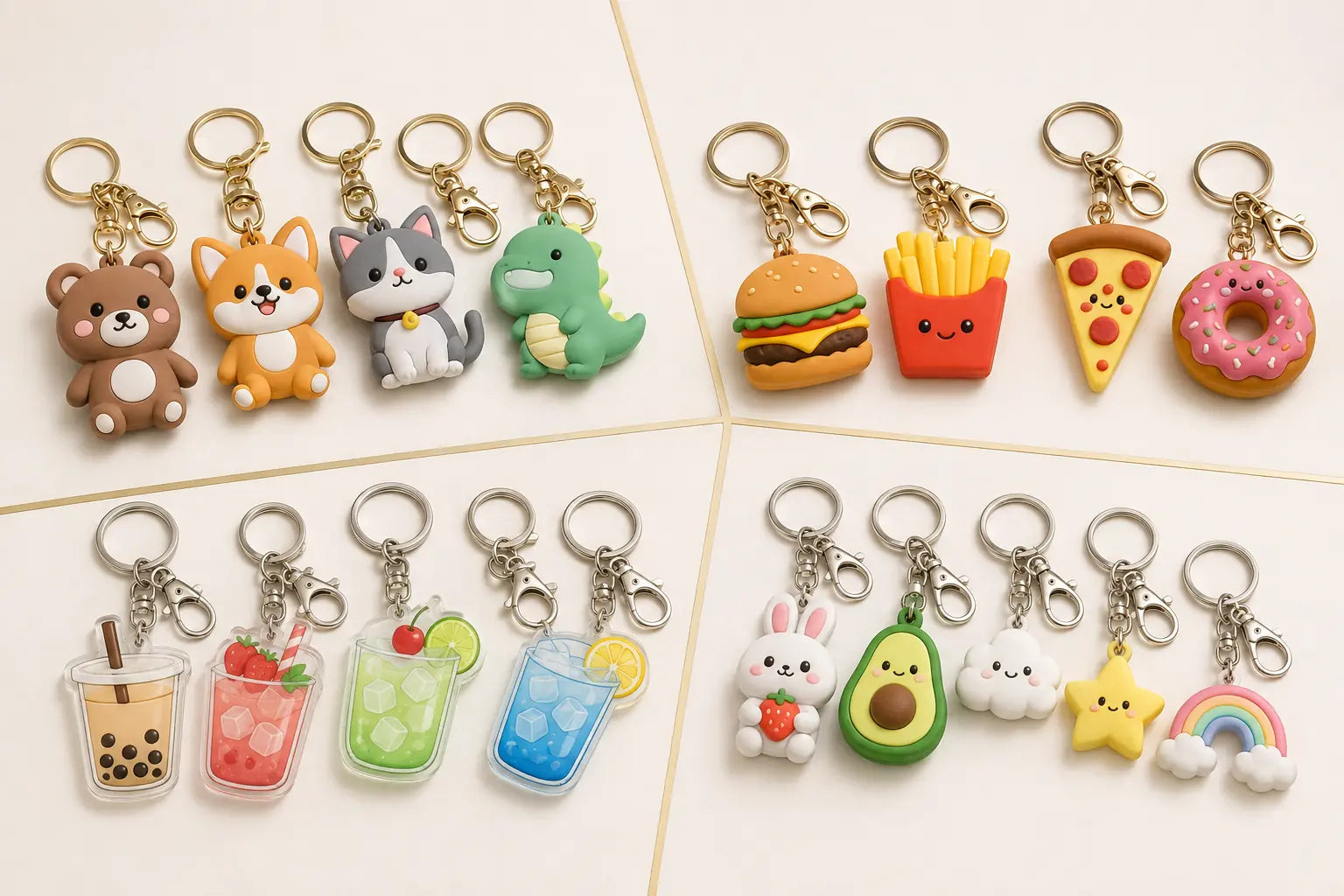
A mixed cute assortment can help a retailer test customer response without building the entire offer around one design. The Wholesale Cute Cartoon Keychains ACCVIP-KC-RONGX007 can be evaluated for design mix, sellable yield and fit with the retailer’s audience.
PVC Cartoon Keychains for Add-On Sales
A soft PVC style can work as an accessible add-on when its surface, odor, color and attachment quality meet the retailer’s standard. The Wholesale Cartoon PVC Soft Keychains provide a concrete item for evaluating those checks.
Silicone Cartoon Keychains for Material Differentiation
A silicone style can differentiate an assortment through feel and appearance, but surface finish and dust attraction should be inspected. The Wholesale Cartoon Cute Silicone Keychains can be compared with PVC and acrylic options before a deeper order.
Acrylic Drink-Themed Keychains for Curated Collections
A drink-themed acrylic design can support a food, café or gift collection when the printing, edges and surface condition are acceptable. The Acrylic Milk Tea Cup Keychain shows how theme-based merchandising can extend beyond a generic assortment.
What Our Cartoon Keychain Selection Experience Prioritizes
The cheapest cartoon keychain is not automatically the most profitable item in our product-selection experience. We first examine the attachment point, visible finish, color consistency, packaging condition and fit with an existing retail theme. A slightly higher product cost may deliver a better commercial result when fewer units are rejected and a larger percentage of the inventory sells.
We would separate a test assortment into customer-facing themes before comparing performance. Animal, food, soft PVC, silicone and acrylic designs may appeal to different shoppers, so treating every cartoon design as interchangeable hides useful information. Product views, add-to-cart behavior, completed sales, returns and remaining inventory should be recorded by design or theme.
We would reorder a proven style only after checking both customer demand and sellable yield. A product may generate interest but still underperform if attachment failures, scratches, color inconsistency or packaging damage make too many units difficult to sell. This process is an operational selection method, not a claim that a particular product has already generated a stated sales result.
Pros of Starting a Cartoon Keychain Business
The main advantages of a cartoon keychain business are its accessible test size, compact inventory and flexible merchandising. These qualities can make the category practical for small retailers, but each advantage contributes to profit only when the seller measures costs and demand.
Cartoon Keychains Can Have a Relatively Low Testing Barrier
Cartoon keychains can be tested with less space and capital than many larger product categories. Their compact form allows a retailer to compare several designs within a controlled inventory plan. The actual barrier still depends on current supplier quantities, shipping costs and the number of styles included.
Cartoon Keychains Are Lightweight and Easy to Store
Compact inventory can reduce storage and display pressure for a small seller. Keychains can fit in drawers, peg displays, counter containers or small shipping packages, although international freight may still be affected by total shipment weight, packaging volume and carrier rules. The seller should calculate the complete shipment rather than assume every small item is inexpensive to import.
Cartoon Keychains Support Bundles and Add-On Sales
Bundles and add-ons can improve order economics by spreading fulfillment costs across more merchandise. A retailer might offer a three-keychain set, a matching-friend set, a backpack-accessory bundle or a small themed gift group. The bundle must still be priced from its complete cost rather than created through an unmeasured discount.
Add-on positioning can be especially useful when a store already attracts customers for bags, jewelry, stationery or gifts. The keychain does not need to carry the full cost of customer acquisition when it is attached to an existing order. Retailers expanding beyond cartoon styles can compare the broader wholesale keychains assortment for complementary products.
Cartoon Keychains Can Be Tested Across Multiple Sales Channels
Cartoon keychains fit several channels because they can be displayed, shipped and demonstrated without complex sizing. Possible channels include an independent store, a marketplace, a gift shop, a market booth, a campus or event stand and social commerce. Each channel should receive its own fee and conversion assumptions because a profitable in-person price may not remain profitable after online advertising and fulfillment.
Cartoon Keychains Support Repeatable Assortment Decisions
A measured test-and-reorder process can improve the assortment over time. Sellers can deepen inventory in designs with proven contribution and sell-through, reduce purchases of weak styles and use controlled clearance for remaining stock. This repeatable process is more defensible than searching continuously for one supposedly viral design.
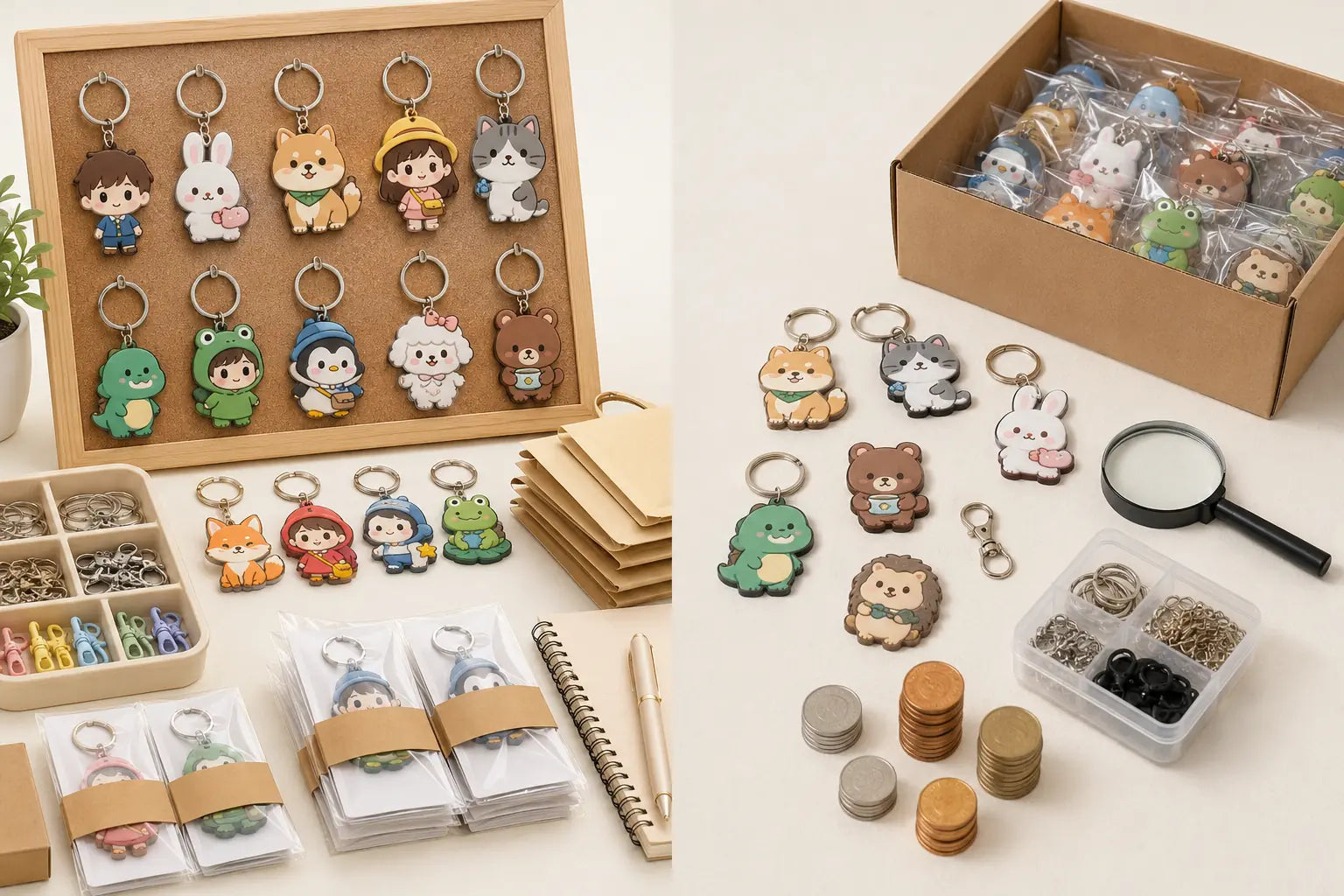
Cons and Challenges of Selling Cartoon Keychains
The main challenges are trend-dependent demand, unsold stock, low order values, selling fees, quality variation and intellectual-property exposure. A credible profitability analysis must include these costs and risks rather than treating compact size and low unit price as proof of easy profit.
Cartoon Keychains Can Become Unsold Inventory
Unsold inventory is one of the largest financial risks in a cartoon keychains business. A low unit price can encourage a seller to purchase too many designs before demand is proven. Remaining products tie up cash, occupy selling space and reduce the order-level profit generated by the designs that did sell.
Trend risk is best controlled through limited tests and planned review dates. Animal, food, facial-expression, seasonal and color themes can rise or fall in popularity, so the seller should define when a design will be reordered, discounted, bundled or discontinued. Waiting indefinitely does not remove the cost of inventory.
Low Order Values Can Reduce Cartoon Keychains Profits
A one-keychain order can leave little profit when fixed per-order work is high. Picking, customer service, labeling and packing require time even when the merchandise value is small. Minimum-order thresholds, bundles, paid shipping rules and relevant add-ons can help, but their effects should be tested rather than assumed.
Marketplace Fees Can Weaken Cartoon Keychains Margins
Marketplace and payment charges can turn an attractive gross margin into a modest contribution. Percentage-based fees, per-listing charges, payment processing, advertising and refund exposure should be assigned to the order or unit. Current official fee pages should always take priority over an old blog post or generic calculator.
Cartoon Keychains May Create Licensing and Copyright Risks
General cartoon-style designs are different from merchandise that reproduces protected characters, artwork, names or logos. A product being available from a supplier does not automatically establish the retailer’s right to market it under a protected brand or character name. Sellers should verify authorization and obtain qualified legal advice when the risk is material.
Trademark and copyright sources help define why famous-character products require additional checks. The USPTO explanation of trademarks states that words, phrases, symbols and designs can identify the source of goods or services, while the U.S. Copyright Office guidance for visual artists explains that original pictorial, graphic and sculptural artwork may receive copyright protection. These official resources support due diligence but do not replace legal advice about a specific product.
Cartoon Keychains Still Require Quality Inspection
Quality inconsistency can reduce both sellable yield and customer trust. Retailers should inspect key-ring attachment strength, connectors, printing position, surface finish, color consistency, odor where relevant, scratches, loose components and packaging damage. A loss allowance in the financial model prevents every received unit from being treated automatically as sellable.
Cartoon Keychains Face Price Competition
Competing only on the lowest displayed price can make the business fragile. A seller may protect margin through clearer photography, trustworthy descriptions, themed selection, bundles, consistent quality and convenient delivery. Retailers comparing sourcing routes can review this cheap keychains supplier comparison without assuming the lowest headline price creates the lowest landed cost.
How to Make a Cartoon Keychain Business More Profitable
A cartoon keychain business becomes more defensible when every reorder is tied to measured contribution, quality and sell-through. The following process limits early exposure and turns the first purchase into a demand test rather than a prediction.
- Define the target customer first. Choose designs for a specific gift, accessory, animal, food, student or bag-accessory audience rather than buying unrelated items only because they appear inexpensive.
- Test multiple designs in controlled quantities. A small mixed assortment reveals more about customer preference than a large commitment to one unproven style.
- Calculate complete landed cost. Include product cost, inbound freight, duties or applicable import charges, packaging and expected quality losses before setting the retail price.
- Build channel costs into every sale. Assign marketplace, payment, advertising, discount, shipping-subsidy and return allowances using the seller’s actual channel.
- Inspect sellable yield on arrival. Record the number of units that meet the selling standard instead of dividing total order cost by every unit received.
- Test individual and bundle offers. Compare conversion, order value and contribution rather than assuming that a higher bundle price is automatically better.
- Track performance by design or theme. Measure product views, add-to-cart activity, completed sales, returns, remaining inventory and contribution over a consistent period.
- Reorder only proven products. Increase inventory when both demand and quality results justify the additional cash commitment.
- Plan an exit for weak inventory. Use a defined discount, bundle or discontinuation rule so slow designs do not remain hidden as permanent assets.
- Review intellectual-property risk before listing. Avoid presenting protected character names, artwork or identifiers as authorized without reliable evidence.
Small Orders Make Cartoon Keychains Testing More Reliable
Small tests reduce the amount of money exposed to an incorrect style prediction. Retailers can compare several ready-made products, identify the designs customers actually purchase and deepen inventory only after demand is visible. A related guide to low-MOQ cartoon keychains for girls provides additional context for focused assortment testing.
Cartoon Keychains Bundles Can Improve Order Economics
Bundles can increase average order value when their discount remains smaller than the efficiency they create. The seller should compare the combined packaging, fee and fulfillment cost of a bundle with multiple single-item orders. Customers still need a coherent reason to buy the set, such as a shared theme, matching pair or gift-ready presentation.
Cartoon Keychains Sell-Through Should Control Reorders
Reorders should follow verified sell-through and contribution rather than page views alone. Attention without completed sales may indicate a price, trust, product or audience problem. Completed sales without adequate contribution may indicate that the offer is popular but financially weak.
Is AccsWholesale Suitable for Sourcing Cartoon Keychains?
AccsWholesale can suit retailers looking for ready-made cartoon keychains wholesale options to compare and test. The category allows buyers to review multiple themes and materials for an assortment, while the product pages provide concrete items for landed-cost and quality evaluation. AccsWholesale should not be described as a custom keychain service because the business opportunity discussed here is based on sourcing ready-made products.
A supplier should be evaluated by commercial fit rather than headline price alone. Retailers should confirm current quantity terms, product specifications, stock, design assortment, destination shipping and total checkout cost before placing an order. The best option is the one that supports acceptable sellable yield, customer fit and landed cost for the retailer’s actual channel.
A broader sourcing comparison can prevent the test from being designed around one purchasing model. Retailers considering components, resale products and other use cases can review where to buy bulk keychain charms, while keeping the current article focused on the profitability of ready-made cartoon designs.
Who Should Start a Cartoon Keychain Business?
A cartoon keychain business is best suited to sellers who can test designs, measure inventory performance and connect the products to a defined audience. Existing accessory, bag, stationery or gift retailers may have an advantage because keychains can extend an established assortment and attach to traffic the business already generates.
- Existing product retailers are suitable candidates when cartoon keychains complement their current customer and order.
- Market and event sellers are suitable candidates when they can display several themes and observe direct customer response.
- Content-led sellers are suitable candidates when they serve a defined interest group and can present relevant designs without relying only on paid advertising.
- Small test-oriented businesses are suitable candidates when they are willing to measure results and change the assortment.
The business is less suitable for sellers expecting one inexpensive product to generate passive profit automatically. It may also be difficult for businesses that depend on paid acquisition for every single low-value order, cannot perform quality checks, do not track inventory by design or intend to sell unverified famous-character merchandise.
Final Verdict: Are Cartoon Keychains Profitable?
Cartoon keychains can be profitable when sellers test multiple designs, calculate complete costs and reorder according to proven sell-through. Their compact size, accessible price and bundle potential create useful retail opportunities, but these advantages do not eliminate platform charges, advertising expense, fulfillment work, inventory risk, quality variation or intellectual-property concerns.
The safest starting strategy is a measured ready-made assortment rather than a large purchase based only on expected retail price. Sellers should calculate contribution per unit, inspect sellable yield, track demand by style and expand only the products that demonstrate both customer interest and acceptable economics. This approach treats profitability as a result to be measured rather than a promise attached to the product category.
Frequently Asked Questions About Cartoon Keychains
What Is a Good Profit Margin for Cartoon Keychains?
A good margin is one that covers all variable and fixed costs while leaving an acceptable return for the seller’s channel and workload. There is no universal percentage because platform fees, advertising, packaging, shipping support, labor and sell-through differ. Sellers should calculate gross margin, contribution and final net profit separately.
How Much Does It Cost to Start a Cartoon Keychain Business?
A small test may be modeled with a few hundred dollars, but the actual startup cost depends on inventory quantity, design count, shipping, packaging, platform and promotion. The $280 example in this article is illustrative rather than a quotation or minimum. A seller should replace every line with current figures and include a reserve for unexpected costs.
How Should I Price Cartoon Keychains?
Cartoon keychains should be priced backward from complete cost and target contribution rather than by applying a markup to supplier price alone. The calculation should include landed product cost, packaging, selling fees, advertising, discounts, shipping support, expected returns or damage and an appropriate share of fixed overhead.
Are Cartoon Keychains Good Products for Beginners?
Cartoon keychains can be suitable for beginners who start small and track results carefully. Their compact size and multiple themes make product testing practical, but low unit cost should not be mistaken for low business risk. Beginners still need quality control, inventory records, accurate pricing and an intellectual-property review.
Should I Sell Cartoon Keychains Individually or in Bundles?
Using both formats is often more informative because individual items lower the purchase threshold while bundles can increase order value. The seller should compare conversion, total contribution and fulfillment efficiency for each format. A bundle is useful only when the theme is coherent and the discount does not eliminate its financial benefit.
What Is the Biggest Risk in Selling Cartoon Keychains?
Unsold inventory is usually one of the biggest direct financial risks, while unverified famous-character merchandise can create a separate legal risk. Small tests, style-level sell-through tracking, clear clearance rules and intellectual-property due diligence help address these different problems.
Do AccsWholesale Cartoon Keychains Support Customization?
This article treats AccsWholesale as a source of ready-made cartoon keychains rather than a custom keychain service. Buyers seeking personalized shapes, artwork, logos or packaging should use a supplier whose current services explicitly cover those requirements.
Test a More Focused Cartoon Keychain Assortment
Compare several ready-made styles, calculate complete landed cost and deepen inventory only after a design proves demand.
Explore Cartoon Keychains
