




Access Denied
IMPORTANT! If you’re a store owner, please make sure you have Customer accounts enabled in your Store Admin, as you have customer based locks set up with EasyLockdown app. Enable Customer Accounts

How Much Do Beaded Pens Sell For? Pricing, Costs & Profit
Geschrieben von AccswholesaleBlog
on

Beaded pens do not have one reliable selling price. In the current Etsy examples reviewed for this guide, three clearly finished physical beaded pens are listed at $7.00, $8.00, and $10.46. Those are current listing examples, not an average selling price, proof of completed sales, or a universal market range.
For a small retailer, the stronger question is: what price works for the sourcing route and sales channel you actually use? Start with two boundaries: current prices for genuinely comparable finished beaded pens, and your true cost floor after product or component cost, inbound shipping allocation, packaging, labor, marketplace fees, payment processing, and other variable selling costs.
The useful result is a viable price window. If your cost floor sits comfortably below a defensible market price, the SKU may be worth testing. If the two are too close, you may need a different blank, component mix, channel, or product position rather than simply applying a larger markup.
AccsWholesale provides one real sourcing-cost reference. Its current finished Cartoon Dog Paw Silicone Beaded Pen is listed at $1.50 with MOQ 3, while its wholesale beadable pens collection also contains lower-cost blanks for sellers who prefer DIY assembly.
Key Takeaways for Beaded Pen Pricing
- Current Etsy reference points reviewed here are $7.00, $8.00, and $10.46 for three finished beaded-pen listings. They are not an average or actual transaction-price dataset.
- A verified AccsWholesale finished silicone beaded pen is currently $1.50 with MOQ 3.
- Current AccsWholesale beadable blanks include a $0.37 plastic example and a $1.75 metal example, so the base alone can materially change the cost floor.
- A verified 20-piece silicone focal-bead pack at $7.59 produces a derived cost of $0.3795 per focal bead if one focal is allocated to each pen.
- Etsy currently charges a $0.20 listing fee and a 6.5% transaction fee. Etsy Payments processing varies by country.
- Low MOQ can matter when testing colors, themes, or customer response. The lowest advertised unit price is not always the lowest-risk buying decision.
- A useful price clears the seller’s real cost floor while remaining defensible against comparable finished products.
This guide answers the commercial decision behind “how much do beaded pens sell for?”: what comparable finished pens are currently listed for, whether finished or DIY sourcing produces the better cost structure, how supplier choice and Etsy fees change the price floor, how to calculate contribution and break-even, where beaded pens can be sold, how 2026 marketplace trends can inform positioning, and when a SKU should be tested, refined, or rejected.
How Much Do Beaded Pens Sell For? Start With Current Reference Points
Finished beaded pens can support different price points because the products themselves are not identical.
The three current Etsy examples selected here are all physical finished beaded pens rather than blanks, digital patterns, or supply packs. One M&M-themed silicone focal pen is listed at $7.00. A separate custom-made beaded pen is $8.00. A personalized wildflower pen is $10.46.
The details explain why these prices should not be averaged mechanically. The $7 example uses a silicone focal with acrylic and silicone beads and refillable ink. The $8 listing describes one finished plastic pen using a silicone focal plus silicone and acrylic accent beads. The $10.46 example adds a custom laser-engraved wood bead, silicone beads, and two ink refills.
These are useful current reference points, not a statistical market range. They do not reveal actual transaction prices, sales volume, conversion rates, or the full distribution of marketplace prices.
This is also why “How much do pens usually cost?” is too broad for this decision. A commodity ballpoint pen and a personalized handmade beaded pen are different retail propositions.
Market Price and Cost Floor Are Two Different Boundaries
A market reference answers, “What prices can shoppers currently see?” A cost floor answers, “What must I recover for this sale to make financial sense?” A workable price needs to survive both.
An $8 price might work for a reseller buying an inexpensive finished product with minimal preparation. It may fail for a seller using a metal blank, several components, paid assembly time, and more expensive packaging.
The article’s decision model is:
Market reference → commercially defensible price context
True cost floor → financially survivable minimum
Viable price window → the space where both can work
True cost floor → financially survivable minimum
Viable price window → the space where both can work
If your cost floor moves too close to comparable prices, the problem may be sourcing or product positioning rather than markup.
Finished Beaded Pens vs. DIY Beadable Pens
Neither route is automatically better. Finished sourcing simplifies the cost structure; DIY sourcing can increase design control but creates more inputs.
Route 1: Buy a Finished Beaded Pen
AccsWholesale currently lists the Cartoon Dog Paw Silicone Beaded Pen at $1.50 with MOQ 3. The page lists SKU ACC-BP-GuangTian042, weight 25 g, material Silicone, Product Type Beaded Pens, and processing of 2–5 business days.
For a reseller, the main advantage is clarity: the $1.50 price is attached to a finished beaded pen rather than just a blank.
Finished product cost + inbound shipping allocation + packaging + channel costs + other variable costs
There may still be inspection, labeling, fulfillment, and acquisition work, but no decorative assembly stage is required.
Route 2: Build From a Lower-Cost Plastic Blank
AccsWholesale currently lists a V Electroplating Plastic DIY Bead Pen at $0.37 with MOQ 2, SKU ACC-PN-HuaHao020, weight 6 g, and material Plastic. A separate multi-color plastic beadable pen is $0.50 with MOQ 2, SKU ACC-PN-HuaH178, weight 10 g, and material Plastic.

A verified 20-piece silicone focal-bead pack costs $7.59. If one focal is allocated to each pen:
$7.59 ÷ 20 = $0.3795 per focal
With the $0.37 blank:
$0.37 + $0.3795 = $0.7495
With the $0.50 blank:
$0.50 + $0.3795 = $0.8795
These are known-component subtotals, not finished unit costs. Additional beads, spacers, packaging, assembly labor, inbound shipping, and channel costs still have to be added where they apply.
Route 3: Use a Higher-Cost Metal Blank
AccsWholesale currently lists an Empty Metal Beadable Pen at $1.75 with MOQ 1, SKU ACC-BP-BF003, weight 20 g, and material Metal.
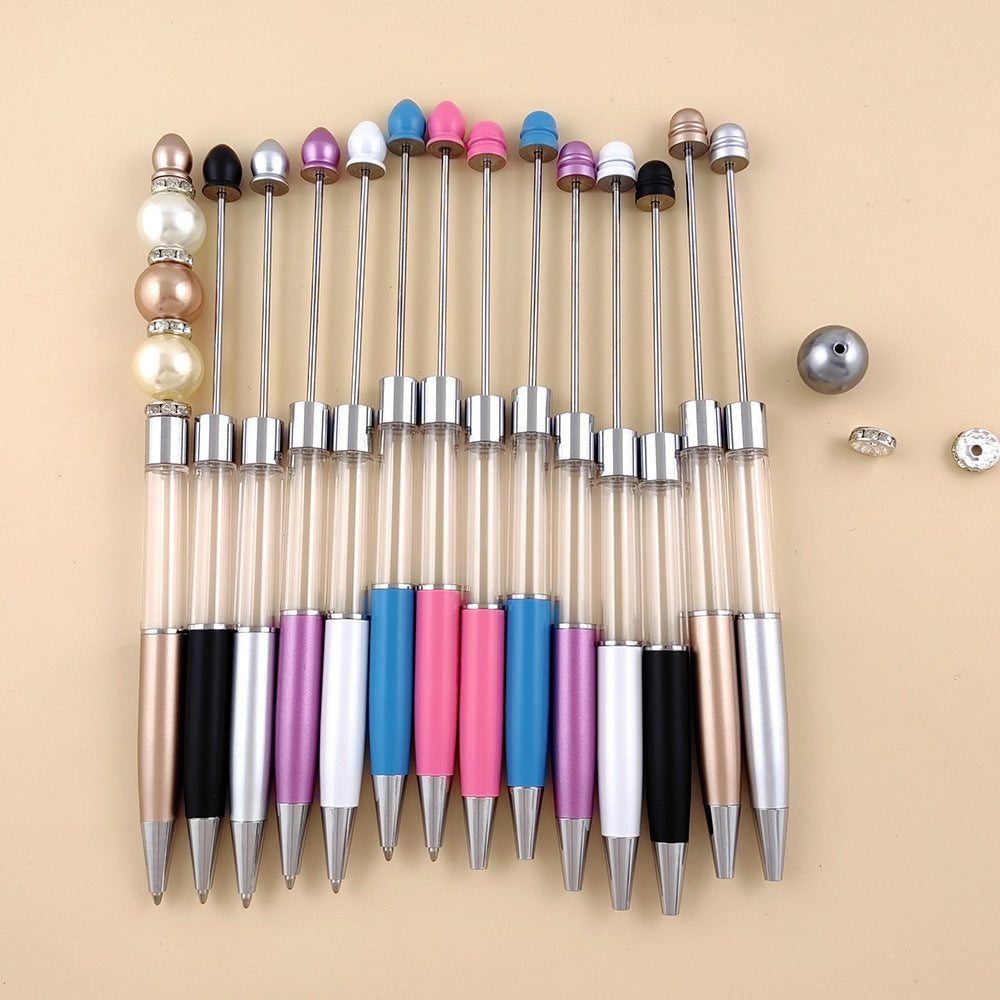
A verified 10-piece Western/Sunflower silicone focal-bead pack costs $4.75. If one focal is allocated to each pen:
$4.75 ÷ 10 = $0.475
Known component subtotal:
$1.75 + $0.475 = $2.225
That is already above the $1.50 finished example before labor, additional components, packaging, shipping, and selling fees. DIY therefore does not automatically mean cheaper; a higher-cost base needs a product position that can support the higher cost floor.
Beaded Pen Supplies Wholesale: How Supplier Choice Changes the Price Floor
Supplier comparison matters when it explains the economics, not when it becomes a generic “best supplier” ranking.
AccsWholesale represents a low-MOQ wholesale route in the locked evidence: MOQ 2 on the $0.37 plastic blank, MOQ 1 on the $1.75 metal blank, and MOQ 3 on the $1.50 finished silicone beaded pen.
Faire represents a multi-brand wholesale marketplace. Its current beadable-pens area includes multiple relevant brands and product types, but wholesale prices are locked for unauthenticated visitors, so it is useful here as evidence of supplier breadth rather than a source for an invented public unit price.
Alibaba represents a factory/import marketplace route. Current locked listing snapshots include different advertised unit prices and MOQs ranging from very small quantities to 100 or 200 units. Those are listing snapshots, not one permanent “Alibaba price.”
Beadables states that its wholesale DIY products have no minimum order requirement. One current Featherlight Pens example is a set of 12 for $32, or about $2.67 per pen before other costs. Beadable Bliss currently shows selected metallic beadable pens from $0.35 and UV-coating pens from $0.60 in its specialist supply collection.
The decision is therefore about fit. A seller validating a theme may prioritize low commitment. A seller with repeat demand may prioritize scale economics. A handmade seller may value component breadth, while a reseller may pay more for a finished product to reduce assembly work.
How Etsy Fees Change a $7, $8, or $10.46 Price
Marketplace fees reduce what remains after the customer pays the sticker price.
Etsy’s current official fee schedule lists a $0.20 listing fee and a 6.5% transaction fee on the total order amount. A listing expires after four months. Etsy Payments processing is separate and varies by country, so this article does not invent one universal processing percentage.
Using only the verified $1.50 finished AccsWholesale pen, the $0.20 listing fee, and the 6.5% transaction fee:
These are not profit figures. Payment processing, packaging, shipping, labor, advertising, taxes where applicable, and other seller-specific expenses have not been deducted.
The calculation exposes a common mistake: “I bought it for $1.50 and sold it for $8, so I made $6.50” ignores the costs between revenue and real contribution.
Contribution and Break-Even Matter More Than a Generic Markup Rule
A practical formula is:
Contribution per unit = selling price − variable costs
The U.S. Small Business Administration uses:
Fixed costs ÷ (price − variable costs) = break-even point in units
It also relates contribution margin to the difference between selling price and variable cost relative to selling price.
This helps separate three questions: what the customer pays, what varies with each sale, and how much each sale contributes toward fixed costs and eventual profit.
Two sellers can both charge $8 and have very different economics because their sourcing route, labor burden, shipping, and selling fees differ. That is why the earlier calculations are described as amounts remaining after a limited set of known costs—not gross profit, net profit, or final margin.
The Viable Price Window: BUY, REFINE, or REJECT
A price is useful only if the business can actually operate inside it.
BUY / TEST
Use this outcome when a defensible selling price leaves meaningful room above the cost floor and the initial inventory commitment is controlled.
Low MOQ matters here because it limits the cost of being wrong while a seller tests colors, themes, or finished styles.
REFINE
Use this outcome when the concept may work but the margin is too narrow.
Possible changes include choosing another blank, simplifying components, improving batch assembly, changing packaging or channel, or adding real differentiation through personalization or design.
REJECT
Use this outcome when realistic costs consume too much of the defensible price and the product has no clear reason to command more.
A larger order can lower some unit costs, but it can also increase cash tied up in a weak SKU. Scale should follow validated economics, not substitute for them.
Where Can I Sell My Beaded Pens?
The channel changes the cost equation.
Etsy: use the official Etsy fee schedule, including the verified listing and transaction fees plus the seller’s country-specific processing cost.
Owned online store: use the payment-processing and customer-acquisition costs that actually apply to that store rather than assuming that removing an Etsy fee creates the same amount of additional profit.
Craft fairs: use the event-specific booth, payment, travel, display, and inventory costs that actually apply. Inventory quantity is a separate planning question from unit pricing.
Boutiques or wholesale resale: remember that the receiving retailer also needs margin room, so a direct-to-consumer price does not automatically imply a viable wholesale price.
The best channel is therefore not simply the one with the highest sticker price. It is the one where net unit economics support the business.
How Popular Are Beaded Pens in 2026?
There is enough evidence to describe beaded and beadable pens as an established commercial niche, but not enough locked evidence to claim that beaded pens themselves are “booming” or growing at a specific rate in 2026.
The current environment includes a dedicated Faire wholesale beadable-pens area, specialist beadable-product suppliers, AccsWholesale’s Beadable Pen collection, and current Etsy finished-product listings. That proves commercial availability and marketplace participation, not a quantified demand-growth rate.
Etsy’s Spring and Summer 2026 Seller Trend Report provides broader positioning context. Published March 17, 2026, it highlights expressive and handcrafted details, personalization and gifting occasions, playful “World of Whimsy” products, and an analog/journaling revival. Teacher gifts and personalization also appear in its graduation shopping themes.
Those trends can inform tests around personalized pens, themed silicone beaded pens, teacher gifts, playful stationery, or journaling-adjacent designs. They cannot support a claim that beaded pens themselves grew by a specific percentage.

Real User Feedback: Bead Compatibility Can Affect Cost
Compatibility can create wasted inventory and extra sourcing work.
In a 2026 r/Beading discussion, one user reported difficulty finding enough large-hole beads for this type of pen, and the original poster agreed that finding the right size beads for pens can sometimes be difficult.
That is anecdotal evidence, not an industry survey, so it should not be generalized to most sellers. It is still a useful operational warning: verify the actual blank-and-bead combination before buying deeper component inventory.
The locked evidence does not establish one universal bead-hole specification for every AccsWholesale beadable pen, so this guide does not invent one.
A Practical Sourcing and Pricing Workflow
The safest sequence is market → product route → landed cost → channel cost → price → inventory.
Step 1: Define the Finished Product
Decide whether the customer is buying a ready-made silicone beaded pen, a personalized handmade beaded pen, a teacher-gift design, a rhinestone style, or another defined offer.
Step 2: Choose Finished Sourcing or DIY Assembly
For finished resale, start with the verified wholesale product price. For beaded pens DIY, record the blank, focal bead, accent beads, spacers, refill, packaging, and every other component actually used. Treat labor as a real seller-specific input.

Step 3: Calculate Landed Cost
AccsWholesale’s current shipping policy says most orders require about 2–5 business days before shipment and that shipping cost varies with destination, parcel weight, dimensions, and method, with the final rate determined at checkout.
Use the actual checkout or invoice rather than copying another seller’s shipping assumption.
Step 4: Add Channel Costs
Use the current official fee schedule for the marketplace or payment system you actually use.
Step 5: Compare Like With Like
Compare finished products with genuinely similar finished products. A personalized $10.46 example is not evidence that a basic undifferentiated pen should also sell for $10.46.
Step 6: Decide the Test Rule Before Scaling
Define what result will cause you to reorder, refine, or stop. A slightly higher unit cost with low MOQ may be safer during testing than a lower unit cost tied to much deeper inventory.
Three Verified Cost Scenarios
Case 1: Finished Wholesale Resale
Known merchandise input:
Finished Dog Paw Beaded Pen = $1.50
MOQ = 3
This route minimizes decorative assembly complexity. A seller considering a $7 or $8 test must still add actual shipping allocation, packaging, payment processing, labor, and applicable channel costs.
Decision: potentially useful for a controlled finished-product test; the $1.50 supplier price alone is not the profit calculation.
Case 2: Lower-Cost DIY Merchandise Subtotal
Plastic blank = $0.37
One focal from a $7.59 / 20 pack = $0.3795
Known component subtotal = $0.7495
This starts below the $1.50 finished example, but additional components, labor, shipping, packaging, and selling fees can narrow the difference.
Decision: potentially attractive when customization creates value and assembly remains efficient.
Case 3: Higher-Cost Metal DIY Merchandise Subtotal
Metal blank = $1.75
One focal from a $4.75 / 10 pack = $0.475
Known component subtotal = $2.225
This already exceeds the finished $1.50 example before other costs.
Decision: treat this as a different product position. A higher-cost base needs a defensible reason—such as presentation, design, gifting, or personalization—for customers to accept a higher price.
Frequently Asked Questions About Beaded Pen Pricing
How much do people sell their beaded pens for?
The current finished-product examples reviewed here are listed at $7.00, $8.00, and $10.46 on Etsy. They are reference points, not an average and not proof of completed sales.
How much should I sell beaded pens for?
Calculate your true variable cost, compare the product with genuinely similar finished pens, and choose a price that leaves adequate contribution without moving outside a defensible market position.
Where can I sell my beaded pens?
Common routes include Etsy, an owned online store, craft fairs, boutiques, and wholesale resale. The fee and acquisition structure differs by channel, so the same sticker price can produce different economics.
Where can small businesses buy beadable pens wholesale with low MOQs?
AccsWholesale currently has verified blank examples with MOQ 1 or 2 and a finished beaded-pen example with MOQ 3. Faire provides a multi-brand wholesale environment, Alibaba provides factory/import marketplace options with varied MOQs, and specialist suppliers such as Beadables and Beadable Bliss focus on beadable products and supplies.
Is it cheaper to buy finished beaded pens or make them from beadable pens?
Not automatically. A verified finished example is $1.50. A $0.37 blank plus one focal allocated from a 20-piece pack produces a $0.7495 known-component subtotal, but the DIY figure excludes additional components, labor, packaging, shipping, and selling costs.
Are silicone beaded pens more profitable?
Material alone does not determine profitability. The full cost structure and the customer’s willingness to pay for the finished design matter more.
Are beaded pen kits better for beginners?
A kit may simplify sourcing, but it does not guarantee the lowest cost or correct compatibility. Compare what is included, resulting unit cost, component fit, and replacement availability.
What size beads should I use for beadable pens?
Do not assume one universal size. The locked evidence does not verify one bead-hole specification for every AccsWholesale pen. Verify the exact blank and bead combination before buying deeper inventory.
How popular are beaded pens?
Current wholesale and marketplace activity supports describing them as an established niche. Broader 2026 Etsy trends support personalization, handcrafted detail, playful design, gifting, and analog/journaling contexts, but not a specific beaded-pen growth rate.
What is the biggest pricing mistake?
Treating the blank or wholesale product price as the complete cost. Add all applicable components, shipping, packaging, labor, marketplace fees, payment processing, and other variable costs before treating the remainder as contribution or profit.
How Much Do Beaded Pens Sell For Overall?
So, how much do beaded pens sell for?
Current finished Etsy examples reviewed here are listed at $7.00, $8.00, and $10.46. Those are useful reference points, but they should not be copied as an average or universal selling range.
A small retailer should build a viable price window instead.
Start with comparable finished-product prices. Then calculate the cost floor for the sourcing route you actually use. A seller may buy a finished $1.50 wholesale beaded pen, begin with a $0.37 or $0.50 plastic beadable blank, use a $1.75 metal blank, or combine a blank with separately purchased focal beads. Each route creates different unit economics.
Next, add the costs that are not visible in the supplier price: actual inbound shipping, packaging, labor, marketplace fees, payment processing, and other variable selling expenses.
If a defensible selling price leaves enough room above that cost floor, test the SKU with controlled inventory.
If the room is too narrow, refine the sourcing route, components, product position, or channel.
If the economics still do not work, reject the SKU rather than assuming a bigger order or higher sticker price will automatically fix it.
The practical answer is not one magic number. The right beaded-pen price is the price where current market expectations and your own verified cost structure leave enough room for the business to work.
Compare Beadable Pen Costs Before You Scale
Review current beadable pen styles, MOQ and product prices, then calculate your own landed cost, channel fees and viable selling-price window before placing a deeper order.
Explore Wholesale Beadable PensResearch note: Product pages, marketplace examples, official fee information, 2026 trend material and cited user discussion were verified before this Gate 6 template conversion. Prices, MOQ, availability, marketplace listings, fees and shipping terms can change; recheck current official pages immediately before publication or ordering.
Related Posts

How to Make Beaded Pens: Supplies & Step-by-Step Guide
Learn how to make beaded pens using purpose-built pen blanks, compatible focal and spacer beads, and a careful dry-fit process....
Mehr lesen
Where to Buy Keychain Rings: Types, Prices & Low-MOQ Suppliers
This guide explains where to buy keychain rings for small businesses comparing low-MOQ sourcing options. It covers split rings, colored...
Mehr lesenInvalid password
Enter