




Access Denied
IMPORTANT! If you’re a store owner, please make sure you have Customer accounts enabled in your Store Admin, as you have customer based locks set up with EasyLockdown app. Enable Customer Accounts

Where to Buy Gold Plated Jewelry Wholesale With Low MOQs
Publié par AccswholesaleBlog
on

Retailers looking for where to buy gold plated jewelry wholesale with low MOQs should compare direct wholesale catalogs, multi-brand marketplaces, specialist suppliers, and factory marketplaces—but they should compare them by minimum inventory commitment, not simply by the smallest MOQ number shown on a page.
AccsWholesale is relevant for small retailers because several currently verified gold-plated products have MOQ 1 or 2, including necklaces, earrings, and rings made from stainless steel, 304 stainless steel, and copper. Its broader Gold Plating Jewelry collection currently shows 869 products and an availability filter with 866 in stock, giving retailers a category-level assortment rather than a single-product landing page.
Faire uses a different purchasing structure: its current gold-plated jewelry marketplace says there is no minimum on opening orders and offers more than 1,100 low-minimum options from multiple brands. JoyasDeChina has a verified gold-plated 304 stainless-steel product with MOQ 1. Asonsteel provides a useful contrast with a verified 18K gold-plated, PVD-coated 304 stainless-steel ring requiring 12 pieces per style. Alibaba is broader still: its current supplier page shows different listings at MOQ 3, 10, 12, and 50, so it cannot be assigned one universal MOQ. JewelryBuyDirect states that its gold-plated collection has no MOQ and a catalog exceeding 120,000 SKUs.
The real buying question is therefore: How much money and inventory must a retailer commit before learning whether a particular gold-plated jewelry design can actually sell? That is the decision this guide is designed to answer.
Key Takeaways for Buying Gold-Plated Jewelry Wholesale
- Low MOQ is useful when it lowers the retailer’s commitment to an unproven design. A one-piece SKU minimum, a brand opening-order rule, and a 12-piece-per-style minimum measure different things.
- “18K gold plated” is not a complete material specification. Retailers still need the base metal, disclosed plating process, product weight, dimensions, MOQ, price, and documented performance claims.
- New retailers can use shallow inventory to test more product hypotheses. The purpose is to learn which designs, materials, categories, and price points deserve deeper inventory.
- The first wholesale order should answer a purchasing question rather than simply maximize the number of pieces bought for the lowest price.
Why Is Gold-Plated Jewelry a Relevant Retail Sourcing Question in 2026?
The strongest 2026 market signal is affordability pressure from high gold prices, not proof that gold-plated jewelry itself is automatically growing.
The World Gold Council reported Q2 2026 global gold-jewelry consumption of 278.2 tonnes, down 17% year over year. At the same time, the global value of jewelry demand reached US$86 billion in the first half of 2026, up 22% year over year. The organization says elevated prices continued to constrain affordability and pushed consumers in many markets toward lighter-weight products and, in some markets, lower-carat designs.
JCK’s May 2026 industry coverage identifies gold pricing pressure as a major issue shaping retail strategy. Brands interviewed by JCK described balancing visual impact with price, weight, smarter construction, versatility, and materials that can justify the customer’s spending.
Neither source proves that demand for wholesale gold-plated jewelry is increasing. What they establish is a market environment in which retailers have a stronger reason to examine the relationship between gold appearance, product construction, retail price, and inventory cost.
For a small boutique, that supports testing rather than assuming. Gold-plated products can provide gold-tone designs at a much lower merchandise cost than solid-gold merchandise, but the retailer still has to prove that its own customers want a particular necklace, hoop, ring, bracelet, or finish.
What Does Low MOQ Mean When Buying Gold-Plated Jewelry Wholesale?
Low MOQ should be separated into at least four purchasing structures: SKU-level minimums, style-level minimums, brand-opening minimums, and supplier-specific marketplace minimums.
This distinction changes how much inventory a retailer must hold.
AccsWholesale provides examples of SKU-level minimum quantities. The verified products in this guide show MOQ 1 or 2 on specific items.
Asonsteel’s verified ring provides a style-level minimum: its product page states that the order starts from 12 and separately specifies “12 pieces per style.”
Faire’s model is different. Its gold-plated marketplace currently says there is no minimum on opening orders and offers more than 1,100 low-minimum options. Its dedicated 18K gold-plated page also says opening orders start at $30. Those are marketplace/brand purchasing conditions, not proof that every individual SKU can be purchased in a quantity of zero or one.
Alibaba demonstrates why marketplace-level claims need extra care. One current gold-plated supplier page contains more than 3,500 results, with visible examples requiring 50 pieces, 10 pieces, 12 sets, and 3 pieces. MOQ therefore has to be checked listing by listing.
Where Can Retailers Buy Gold-Plated Jewelry Wholesale With Low MOQs?
Different suppliers solve different parts of the sourcing problem, so the most useful comparison is based on purchasing structure rather than an overall “best supplier” ranking.
| Supplier | Current verified minimum signal | Model | What it lets a retailer evaluate |
|---|---|---|---|
| AccsWholesale | Selected gold-plated SKUs at MOQ 1–2 | Direct wholesale catalog | Several designs with shallow product-level commitments |
| Faire | No minimum on opening orders; 1,100+ low-minimum options | Multi-brand marketplace | Multiple boutique brands and assortments |
| JoyasDeChina | Verified product at MOQ 1 | Direct wholesale catalog | Individual product-level testing |
| Asonsteel | Verified ring at 12 pieces per style | Specialist/direct supplier example | A deeper commitment to one 18K/PVD 304 stainless-steel style |
| Alibaba | Current visible examples include MOQ 3, 10, 12, and 50 | Factory/supplier marketplace | Supplier-by-supplier production and scale comparisons |
| JewelryBuyDirect | Supplier states no MOQ and 120,000+ SKUs | Broad direct catalog | Very broad assortment and low-quantity ordering |
This table should not be interpreted as a quality ranking. The products are not equivalent.
For example, the Asonsteel ring used here is explicitly described by the supplier as 304 stainless steel, 18K gold plated, and PVD coated, with a 12-piece-per-style minimum.
JoyasDeChina’s verified example is a gold-plated geometric necklace and earring product with MOQ 1, 11g weight, and 304 stainless steel as the stated material. Its current page displays prices beginning around $0.74–$0.76 for the shown styles.
JewelryBuyDirect states that its gold-plated collection has no minimum order quantity and more than 120,000 SKUs. The same page also advertises properties such as tarnish resistance and water resistance. Those performance descriptions remain JewelryBuyDirect’s own claims; this guide does not independently verify them.
The takeaway is that retailers should compare each supplier on the variables that are actually documented.
What Does AccsWholesale Currently Offer for Low-MOQ Gold-Plated Jewelry?
AccsWholesale’s strongest evidence for this topic is its combination of a dedicated gold-plating category and product-level MOQ data.
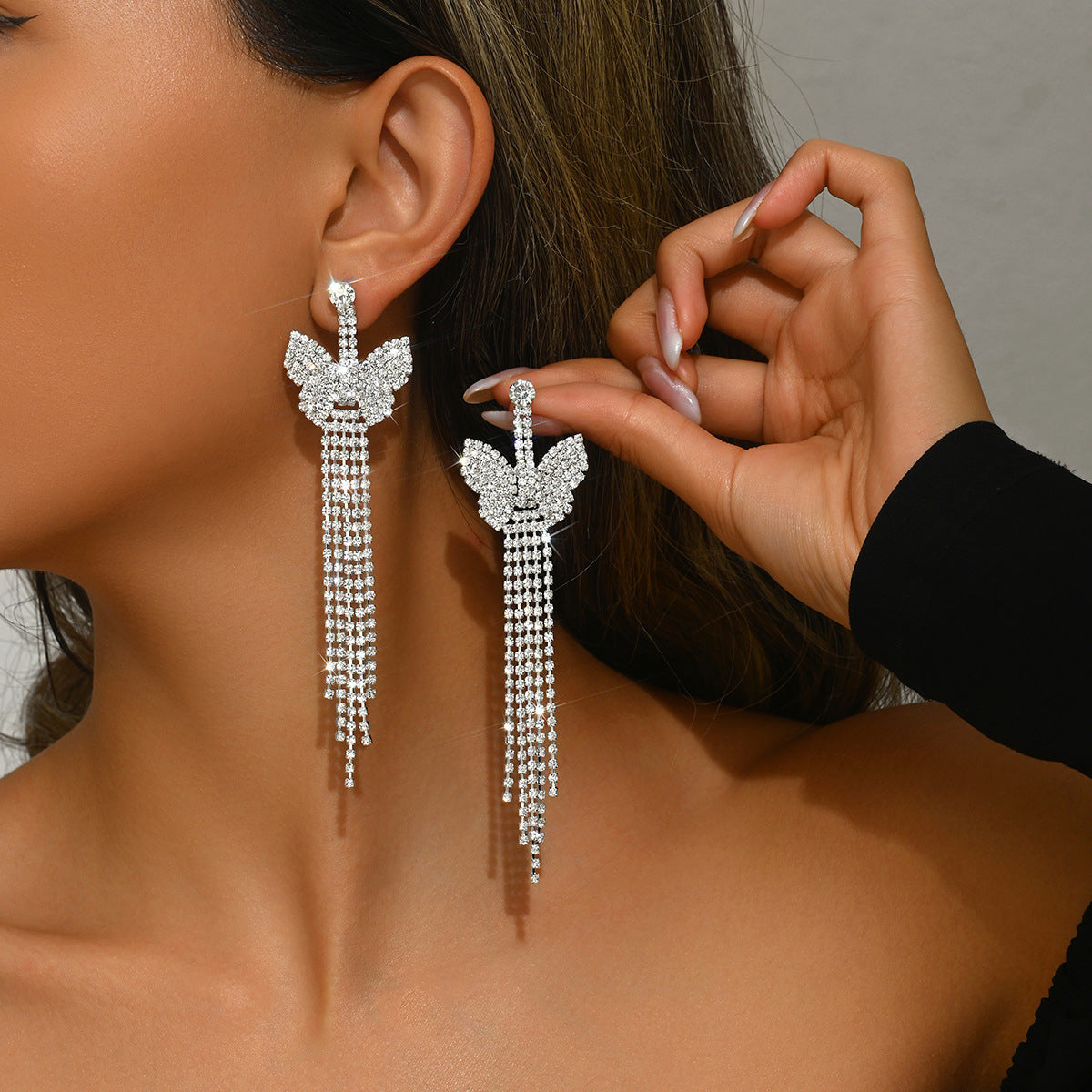
The Gold Plating Jewelry collection currently contains 869 products, with 866 shown under the in-stock filter. The assortment visibly includes earrings, rings, necklaces, bracelets, stainless-steel items, copper items, and other gold-plated designs.
Several individual products illustrate how shallow a test order can be.
The 18K Gold Plated Evil Eye Necklace, SKU ACC-NE-6086860978073-M1, currently lists MOQ 1, a weight of 10g, stainless steel as the material, and a regular price of $1.33.

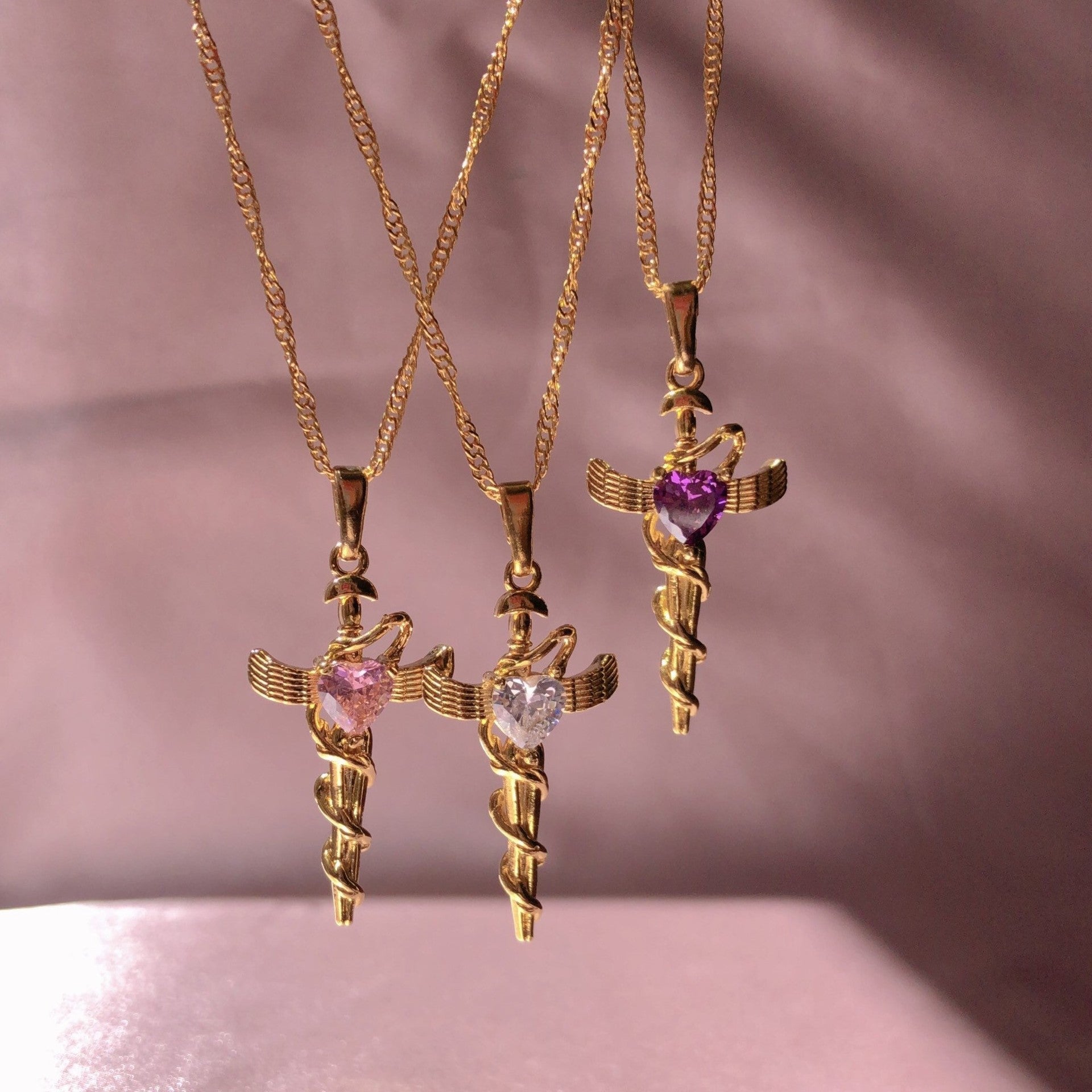
The 14K Gold Plated Cross Snake Heart Zircon Necklace, item ACC-NE-HS002, lists MOQ 2, 10g weight, stainless steel, and a regular price of $3.39.
The Stainless Steel Plated 18K Gold Earrings, SKU ACC-ES-5620023384214-M1, list MOQ 1, 10g, stainless steel, and $1.29.
The Simple Circle Gold Plated Earrings, item ACC-ES-MuShan003, list MOQ 1, 12g, stainless steel, and $1.00. The product also has numerous size and color variants, which is useful when a retailer wants to distinguish variation testing from simply buying more units of one exact option.
The 18K Gold Plated Water Drop Adjustable Ring, item ACC-RS-HeMei001, is especially useful because the product page states that its material is copper, not stainless steel. It currently lists MOQ 2, weight 15g, and price $2.79.
A different gold-plated Evil Eye Open Ring, ACC-RS-6157689867724-M1, lists 304 stainless steel, MOQ 1, weight 6g, and price $1.02.
Together, these products show why gold plated jewelry wholesale cannot be treated as one uniform construction category. Two pieces can both have a gold-colored plated finish while using different base metals, different minimums, and different product specifications.
Retailers looking specifically at necklaces can also review the Gold Plated Necklace collection.
Does 18K Gold Plated Mean the Jewelry Is Higher Quality?
No. “18K gold plated” is one specification, not a complete quality judgment.
The FTC explains that jewelry can receive gold plating through mechanical plating, electroplating, and other processes. It also notes that gold plating eventually wears away depending on factors including how the jewelry is worn and the thickness of the layer.
That means an 18K label does not independently tell a retailer: the base metal, the plating thickness, whether the process is PVD, whether the product is waterproof, whether it is nickel-free, whether it is hypoallergenic, or how quickly the finish will wear in a particular use case.
A retailer should therefore treat “18K gold plated” as one line in the specification sheet.
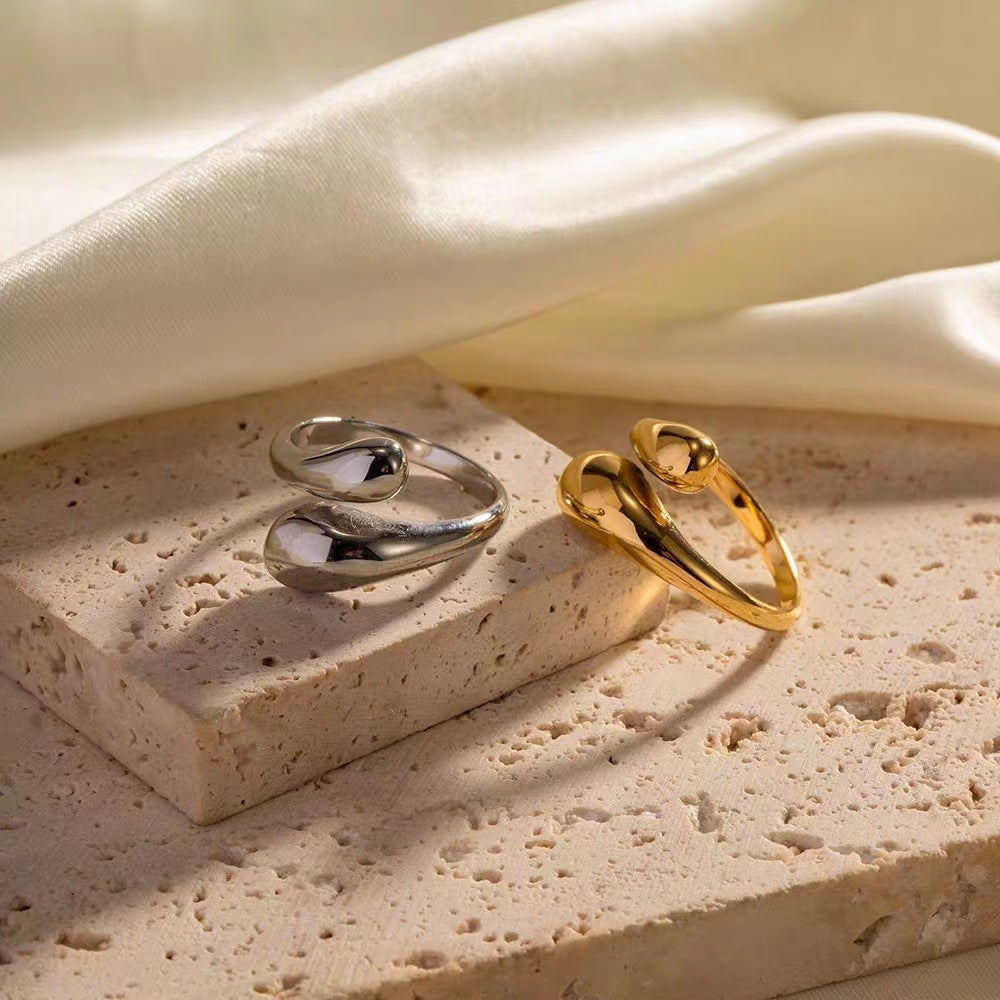
The AccsWholesale examples demonstrate why. The Water Drop ring is an 18K gold-plated copper product, while the Evil Eye ring specifically identifies 304 stainless steel. Those base-metal facts matter independently of the gold-plated appearance.
Asonsteel’s ring is different again: the supplier specifically states both 18K gold plating and PVD coating. That PVD description is valid for the verified Asonsteel example because the official product page states it. It should not be copied onto an AccsWholesale product whose product page does not provide the same information.
What Is Gold-Plated Sterling Silver, and Is It the Same Thing?
Gold-plated sterling silver is not the same material as gold-plated stainless steel or gold-plated copper.
FTC consumer guidance states that sterling silver contains 92.5% silver. It also defines vermeil as a special type of gold-plated product with a sterling-silver base. Gold-filled and rolled-gold products are separate constructions again.
For retailers, this matters because search terms such as gold plated sterling silver, sterling silver gold plated, and gold plated silver can carry different product and price expectations from inexpensive plated stainless-steel fashion jewelry.
The safest catalog practice is therefore to preserve the supplier’s verified material terminology.
If the page says 304 stainless steel, list 304 stainless steel.
If it says copper, list copper.
If it says sterling silver, verify that specification before using sterling-silver terminology.
A similar gold color is not evidence of the same base material.
What Are Real Buyers Worried About When Sourcing Gold-Plated Jewelry?
Recent sourcing discussions show that material accuracy and supplier verification matter alongside price and MOQ.
In a 2026 small-business discussion, a prospective jewelry-brand owner specifically sought small-business-friendly MOQs, stainless-steel bases, 18K plating, PVD where available, consistent quality, and reliable shipping. The buyer’s main difficulty was distinguishing genuine suppliers from resellers or companies that might overpromise. This is anecdotal evidence of sourcing concerns, not proof about any supplier in this article.
A separate jewelrymaking discussion focused on another practical concern: whether products advertised as stainless steel might actually be copper or brass with plating. The poster specifically asked how buyers verify the material before ordering.
Another startup discussion about 316L stainless steel and PVD sourcing describes difficulty separating manufacturers from trading companies and asks how to verify actual PVD capability.
Which Product Claims Should Retailers Verify Before Resale?
Retailers should build their customer-facing product descriptions from facts they can document.
The FTC Jewelry Guides focus on truthful representation of jewelry characteristics, including metallic content, quality, weight, treatment, durability, and price.
In practical wholesale sourcing, the useful record for each SKU should include:
- supplier
- product name
- product URL
- SKU or item number
- base metal
- stated plating
- plating process if disclosed
- weight
- dimensions if available
- MOQ
- variant
- current purchase price
- any specific performance claim that the supplier actually documents
The distinction between product fact and marketing claim matters.
“Material: 304 stainless steel” is a directly checkable specification on the AccsWholesale Evil Eye ring page.
“PVD coated” is a stated product specification on the verified Asonsteel ring page.
“Waterproof,” “anti-tarnish,” “nickel-free,” or a specific micron thickness should not be added to another SKU simply because those claims appear elsewhere.
This approach gives retailers a more defensible product catalog and prevents gold-plated jewelry from being reduced to a vague “18K” marketing label.
How Can a Retailer Measure Minimum Test Commitment?
A useful way to compare low-MOQ sourcing is to calculate the minimum merchandise commitment needed to test a defined group of designs.
This is a decision framework for this article, not an industry-standard financial metric.
Using six verified AccsWholesale products, a retailer could theoretically purchase each item at its stated minimum:
Simple Circle Earrings: 1 × $1.00 = $1.00
18K Plated Earrings: 1 × $1.29 = $1.29
18K Evil Eye Necklace: 1 × $1.33 = $1.33
14K Cross Necklace: 2 × $3.39 = $6.78
18K Water Drop Copper Ring: 2 × $2.79 = $5.58
304 Stainless Steel Evil Eye Ring: 1 × $1.02 = $1.02
Merchandise total = $17.00
8 units across 6 product designs
8 units across 6 product designs
The number matters less than what it demonstrates: the retailer can expose relatively little merchandise capital to each individual design while learning across earrings, necklaces, rings, stainless steel, 304 stainless steel, copper, 14K-plated descriptions, and 18K-plated descriptions.
Now compare a different purchasing structure.
The verified Asonsteel 18K/PVD 304 stainless-steel ring requires 12 pieces per style. That creates a 12-unit minimum commitment to one style before shipping and other inbound costs.
That does not prove that the Accs order is better.
The products are not equivalent.
The supplier models are not equivalent.
The manufacturing and finish claims are not equivalent.
The comparison simply demonstrates why “MOQ 1” versus “MOQ 12 per style” changes what a retailer can learn from the first dollars invested.
How Should Retailers Calculate Landed Cost?
Wholesale product price should never be treated as the final inventory cost.
Landed cost = merchandise + allocated inbound shipping + duties/taxes where applicable + retail-ready packaging + other direct inbound costs
The $17 Accs test basket above is merchandise cost only.
For an illustrative scenario, suppose freight, duties, and packaging add $12 across those eight units. This $12 is hypothetical and is not an AccsWholesale shipping quote.
Total landed basket: $17 + $12 = $29
Average landed cost: $29 ÷ 8 = $3.625 per unit
Rounded for planning: about $3.63 per unit
If those eight units later sold at an average of $12 each:
Revenue = 8 × $12 = $96
Illustrative gross profit before payment fees, advertising, labor, returns, discounts, overhead, and income taxes:
$96 − $29 = $67
$67 ÷ $96 × 100 = 69.8% illustrative gross margin
$67 ÷ $96 × 100 = 69.8% illustrative gross margin
This is a teaching example, not a promised margin.
Its purpose is to demonstrate that a product priced at $1–$3 wholesale should not be evaluated without inbound costs.
Actual shipping depends on the order and destination, so retailers should check the current AccsWholesale Shipping Policy and final checkout before calculating a real landed cost.
Is Selling Gold-Plated Jewelry Profitable?
Gold-plated jewelry can produce attractive gross margins, but profitability depends more on landed cost and sell-through than on the plating label itself.
The relevant question is not:
“How cheap can I buy this ring?”
It is:
“How many units must sell, at what retail price, before this SKU produces acceptable gross profit without leaving excess inventory?”
A $1 product with a large minimum can create more unsold inventory than a $2 or $3 product that can be tested shallowly.
Conversely, a higher-MOQ product may make sense after a retailer already knows the design sells consistently.
That is why the low-MOQ advantage is strongest before demand is proven.
The first purchase is an experiment in design demand, base-metal preference, category, price point, and customer response. Deeper purchasing becomes more rational only after the store has evidence from actual sales.
How Should a Retailer Design a First Gold-Plated Jewelry Test?
The first assortment should test distinct commercial questions rather than filling the cart with visually similar products.
For example, a retailer might deliberately include:
- a simple hoop
- a decorative earring
- a symbolic necklace
- a chain or pendant style
- an adjustable ring
- a second ring with a different disclosed base metal
That lets the store compare product type and construction rather than merely comparing colors.
The 2026 market context reinforces this approach. JCK reports that gold pricing pressure is pushing brands and retailers to pay more attention to design impact, weight, versatility, and how value is communicated.
A gold-plated retailer does not need to copy fine-jewelry assortments. But the same commercial logic applies: designs need a reason to exist in the assortment.

Each first-order SKU should answer something:
Do customers prefer simple or symbolic designs?
Do rings outperform necklaces?
Does a lower retail price materially improve conversion?
Does a heavier piece justify a higher price?
Are customers responding to stainless steel, or is design more important than base-metal terminology?
The purpose of low MOQ is to answer those questions while limiting the cost of being wrong.
When Should a Retailer Buy More of a Gold-Plated SKU?
A retailer should increase SKU depth when repeatable sales evidence becomes stronger than the uncertainty that justified the first low-MOQ order.
Useful signals include:
- sell-through
- full-price sales
- gross profit after landed cost
- returns
- product complaints
- reorder price
- supplier stock continuity
- whether the specification remains consistent
For example, selling one of one unit is encouraging but statistically weak.
Selling through several reorders at the intended retail price is a stronger signal.
The retailer can then shift from “Can this sell?” toward “How efficiently can I restock it?”
That is the point where a 12-piece-per-style structure, factory quote, or larger MOQ may become commercially sensible.
Low MOQ is therefore not necessarily the permanent sourcing model.
It is often the learning model before deeper inventory.
Frequently Asked Questions About Gold-Plated Jewelry Wholesale
Where can retailers buy gold plated jewelry wholesale with low MOQs?
Retailers can compare direct catalogs such as AccsWholesale and JoyasDeChina, multi-brand marketplaces such as Faire, specialist supplier products such as the verified Asonsteel 18K/PVD ring, broad direct catalogs such as JewelryBuyDirect, and factory marketplaces such as Alibaba. The important difference is what the stated minimum applies to.
Can I buy gold-plated jewelry wholesale with an MOQ of one?
Yes, selected current products have an MOQ of one. Verified AccsWholesale examples include the 18K Evil Eye Necklace, 18K plated earrings, Simple Circle Earrings, and 304 stainless-steel Evil Eye Ring. JoyasDeChina also has a verified MOQ-one product example. This should not be generalized to every product on either website.
Is 18K gold-plated jewelry better than 14K gold-plated jewelry?
Not automatically. Retailers still need to consider base metal, disclosed plating method, weight, product construction, price, MOQ, and documented performance claims. “18K” by itself does not establish overall durability or quality.
Is gold-plated sterling silver the same as gold-plated stainless steel?
No. Sterling silver contains 92.5% silver, while stainless steel is a different base-metal family. FTC guidance also describes vermeil as a special type of gold-plated product using sterling silver as the base.
Is PVD the same thing as gold plating?
PVD is a coating process and should only be attributed to a product when the supplier documents it. The Asonsteel ring used in this guide explicitly states “PVD Coated” and “18K Gold Plated.” The AccsWholesale products in this guide are not assigned PVD claims because their locked product evidence does not establish that specification.
What should retailers check before ordering gold-plated jewelry?
Check the exact SKU, base metal, stated plating, plating method if disclosed, MOQ, weight, dimensions, variants, price, final shipping cost, reorder availability, and documentation for any durability or compliance claims you plan to repeat.
How much should a retailer spend on the first order?
There is no universal amount. The more useful question is how much merchandise capital the retailer is willing to expose to unproven designs. Low product-level MOQs allow that budget to be distributed across more hypotheses.
Is selling gold-plated jewelry profitable?
It can be, but profit depends on landed cost, retail price, sell-through, returns, advertising, payment fees, packaging, discounts, and unsold inventory. A low purchase price alone does not establish profitability.
Where Should Retailers Buy Gold-Plated Jewelry Wholesale With Low MOQs?
Retailers deciding where to buy gold plated jewelry wholesale with low MOQs should compare how each supplier defines the minimum and how much inventory that minimum forces them to hold before sales are proven.
AccsWholesale currently has a broad Gold Plating Jewelry collection and several verified product examples with MOQ 1–2. Faire provides access to more than 1,100 low-minimum gold-plated options under a multi-brand marketplace model. JoyasDeChina has a verified MOQ-one 304 stainless-steel product example. Asonsteel’s verified ring demonstrates a different model: 18K gold plating, PVD coating, 304 stainless steel, and 12 pieces per style. Alibaba’s current page shows that marketplace MOQ varies by listing, with visible examples at 3, 10, 12, and 50. JewelryBuyDirect states that it offers no MOQ and more than 120,000 SKUs.
For a small retailer, the most useful low-MOQ option is usually the one that allows enough product variation to learn what customers buy while keeping the commitment to each unproven design controlled.
The purchasing question to carry into every supplier comparison is:
How much capital must I commit to this design before I have evidence that it deserves deeper inventory?
Compare Gold-Plated Jewelry for a Low-MOQ Test
Review current styles, materials, MOQ and product prices before deciding which designs deserve deeper inventory.
Explore Gold Plating JewelryResearch note: Public supplier information, official product specifications, industry sources and cited buyer discussions were reviewed in September 2026. Reconfirm current MOQ, product price, material, availability, supplier terms and source pages immediately before publication or ordering.
Related Posts

How to Make Beaded Pens: Supplies & Step-by-Step Guide
Learn how to make beaded pens using purpose-built pen blanks, compatible focal and spacer beads, and a careful dry-fit process....
En savoir plus
Where to Buy Keychain Rings: Types, Prices & Low-MOQ Suppliers
This guide explains where to buy keychain rings for small businesses comparing low-MOQ sourcing options. It covers split rings, colored...
En savoir plusInvalid password
Enter